Firmware security for smart home devices and doorbells

Smart plugs, sensors, hubs and video doorbells are consumer products sold in many markets, and many run on a microcontroller rather than Linux. Every market's rules start with passwords, then ask for a way to report vulnerabilities and a stated period of updates. FDIE checks the firmware and prepares that evidence.

Request access
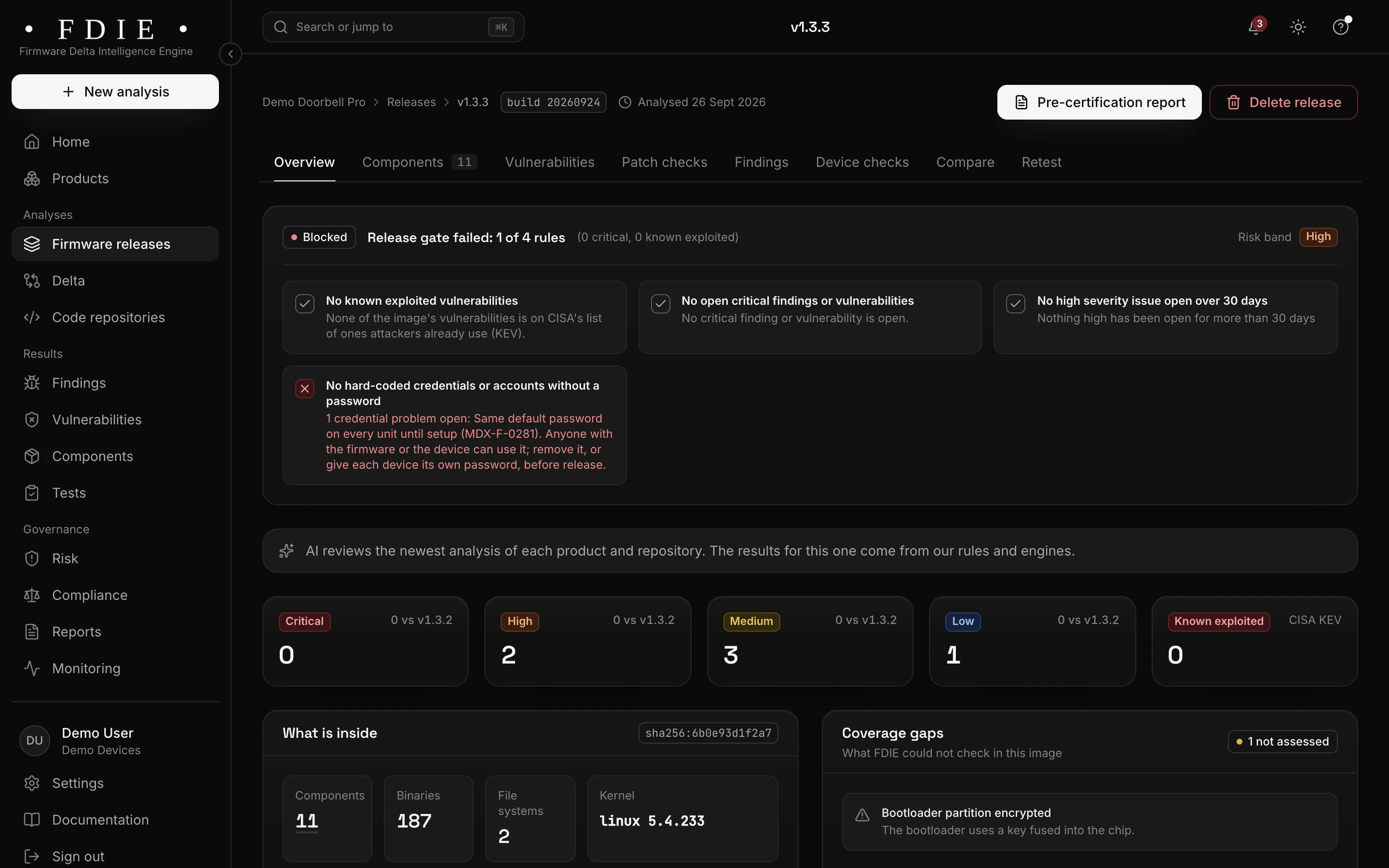
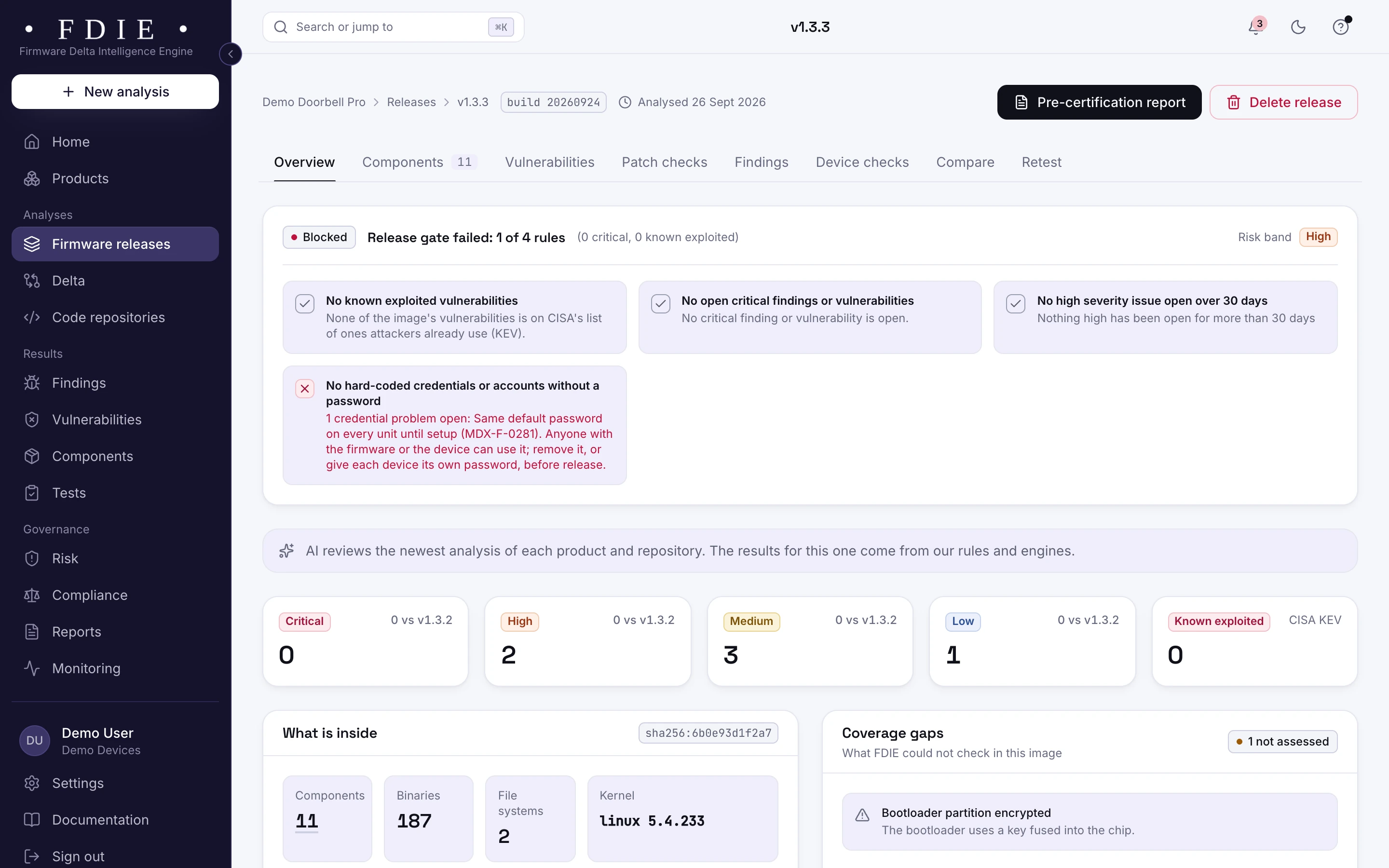
A doorbell firmware release blocked by its release gate because every unit has the same default password until setup, with severity counts, Linux 5.4.233 inside and an encrypted bootloader partition named as a coverage gap.The same screen in the light theme.
A doorbell firmware release from the app's sample organisation: the release gate held on a shared default password, and the encrypted bootloader named as a coverage gap.

The challenge

Where smart home firmware goes wrong

  • Pairing and cloud keys

    Devices pair with an app and talk to a cloud service. A key or token that every unit shares means one extracted device exposes them all.

  • Wi-Fi provisioning shortcuts

    Setup modes with open access points, static WPS PINs or Wi-Fi passwords in the image are easy to ship and hard to recall from customers' homes.

  • Rules written for consumers

    UK PSTI, EN 18031 for radio equipment in the EU and ETSI EN 303 645 expect no universal default passwords, a published way to report vulnerabilities and a stated update period.

How FDIE helps

What changes with FDIE

Microcontroller images, not only Linux

Bare-metal images for ESP32 and Cortex-M are read from Intel HEX, S-record, UF2 and DfuSe files and laid out as one image with its entry point and interrupt handlers. ESP images give the ESP-IDF version and the application's name, and Linux hubs and doorbells are read like any embedded Linux image.

  • ESP32 images on Xtensa and RISC-V, and Cortex-M
  • Components and versions found in the image
  • What cannot be read listed as a coverage gap
How an image is read
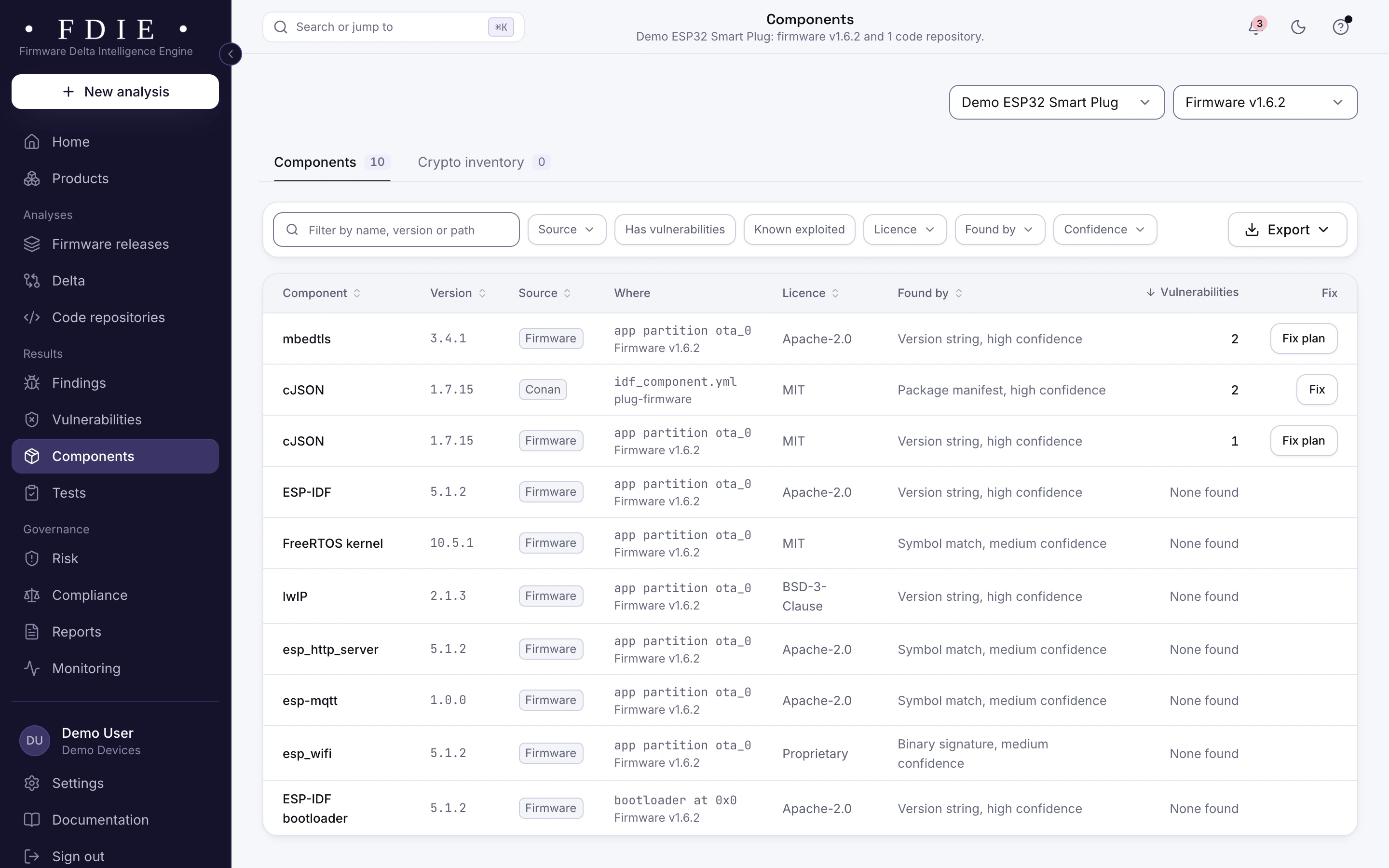
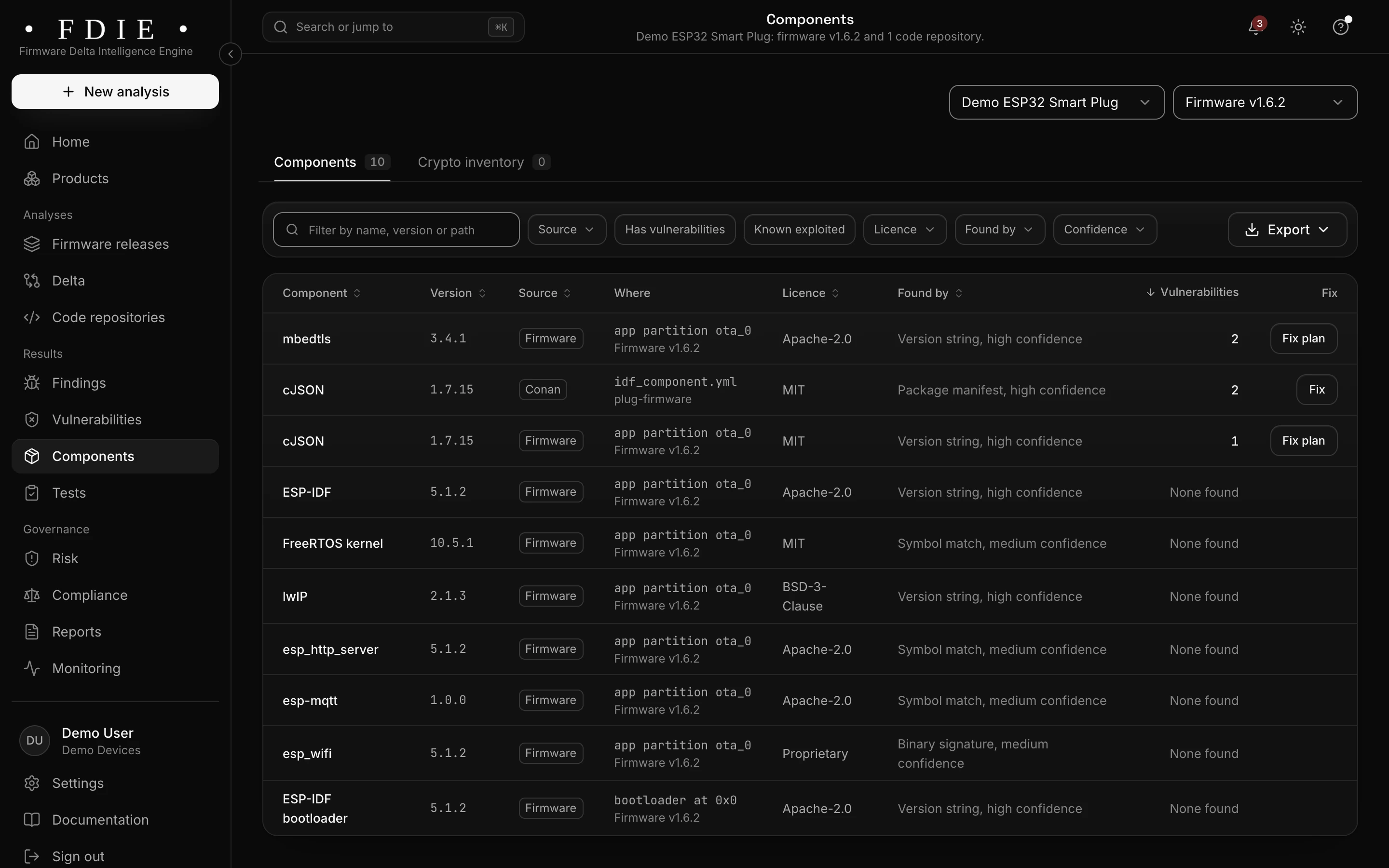
The smart plug's components: mbedTLS, cJSON, ESP-IDF 5.1.2, the FreeRTOS kernel, lwIP and Espressif's HTTP server, MQTT and Wi-Fi libraries in the application partition, found by version strings, symbols and binary signatures.The same screen in the light theme.

Passwords, keys and cloud tokens

Hard-coded passwords, default accounts, private keys, API keys and tokens are found in the image and shown masked. Anything in the image ships on every unit, so a shared private key or cloud token is flagged before one extracted device gives it away.

  • No universal default password, the first thing PSTI asks for
  • Shared private keys and cloud tokens flagged
  • Weak algorithms and short keys in the crypto inventory
Passwords and keys
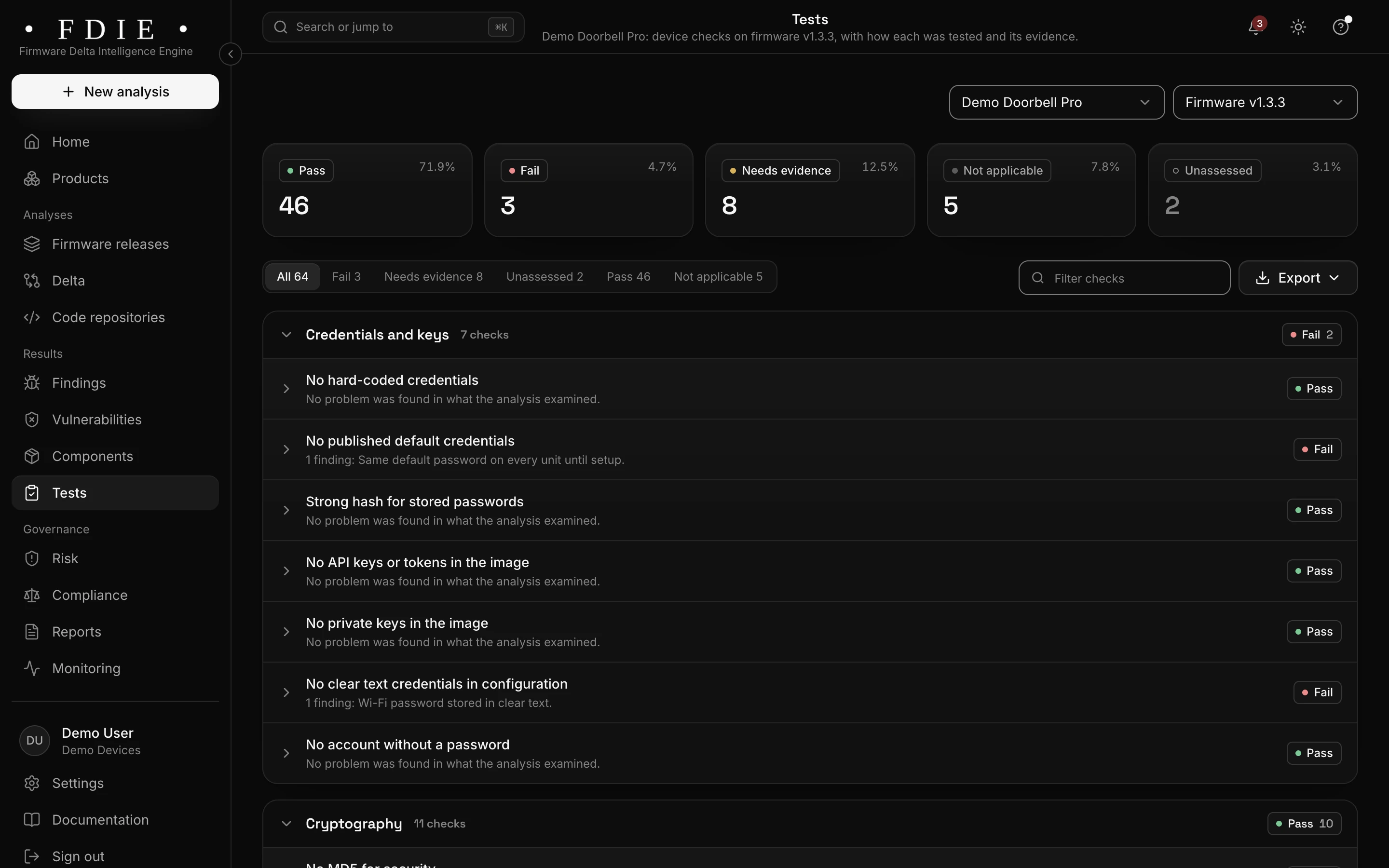
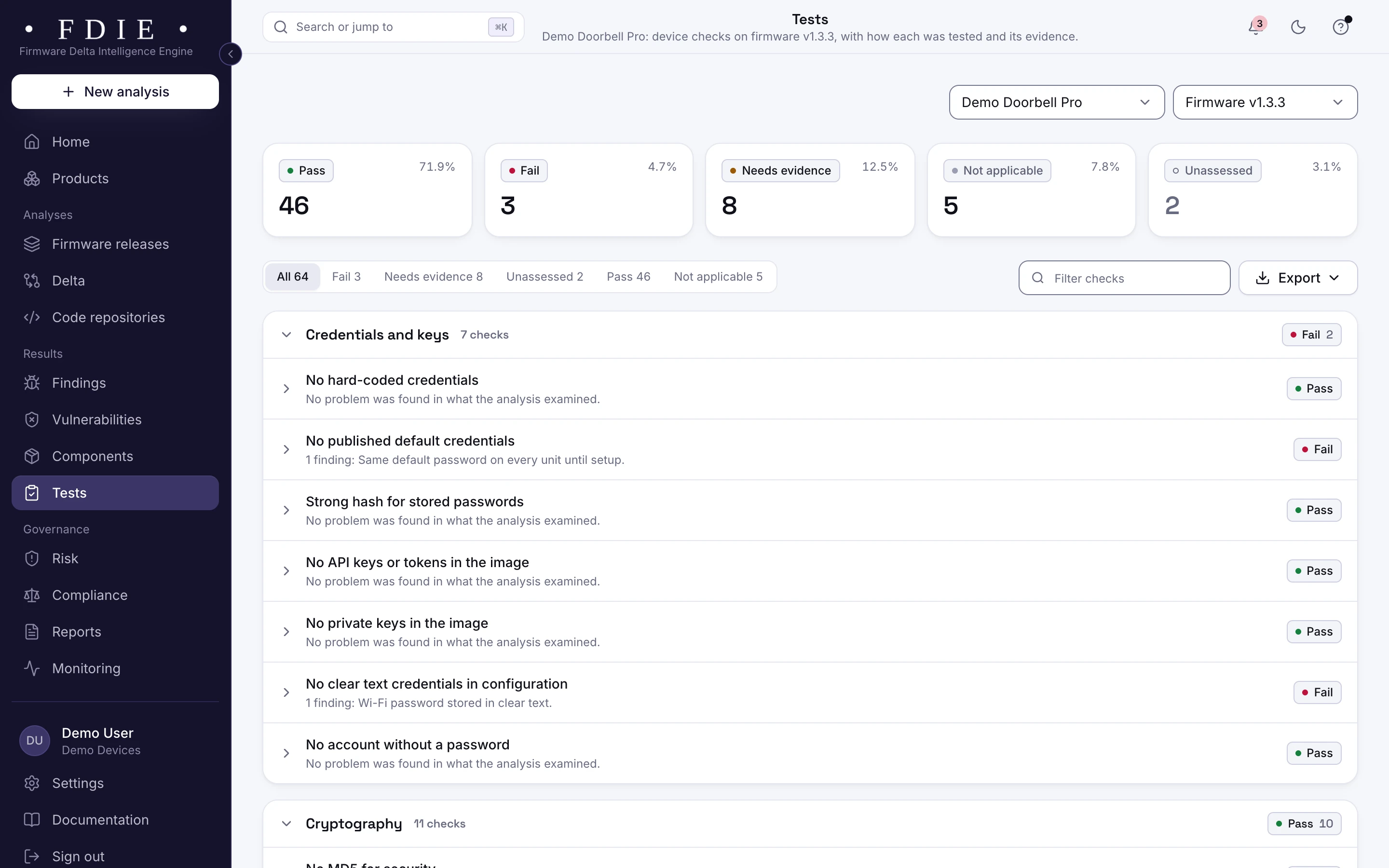
Device checks for the doorbell firmware: 46 pass, 3 fail and 8 need evidence, with the credentials and keys group failing on a shared default password and a Wi-Fi password stored in clear text.The same screen in the light theme.

Updates and provisioning, checked

Device checks look at the update path: signed updates, an encrypted download channel, rollback protection and unsigned updates rejected. With the source connected, rules read ESP-IDF and Zephyr build settings for secure boot and flash encryption, and device settings for Wi-Fi with WEP, WPA1, TKIP or a static WPS PIN.

  • Signed updates and rollback protection
  • Secure boot and flash encryption settings in the build
  • Weak Wi-Fi and static WPS PINs in shipped settings
How device checks work
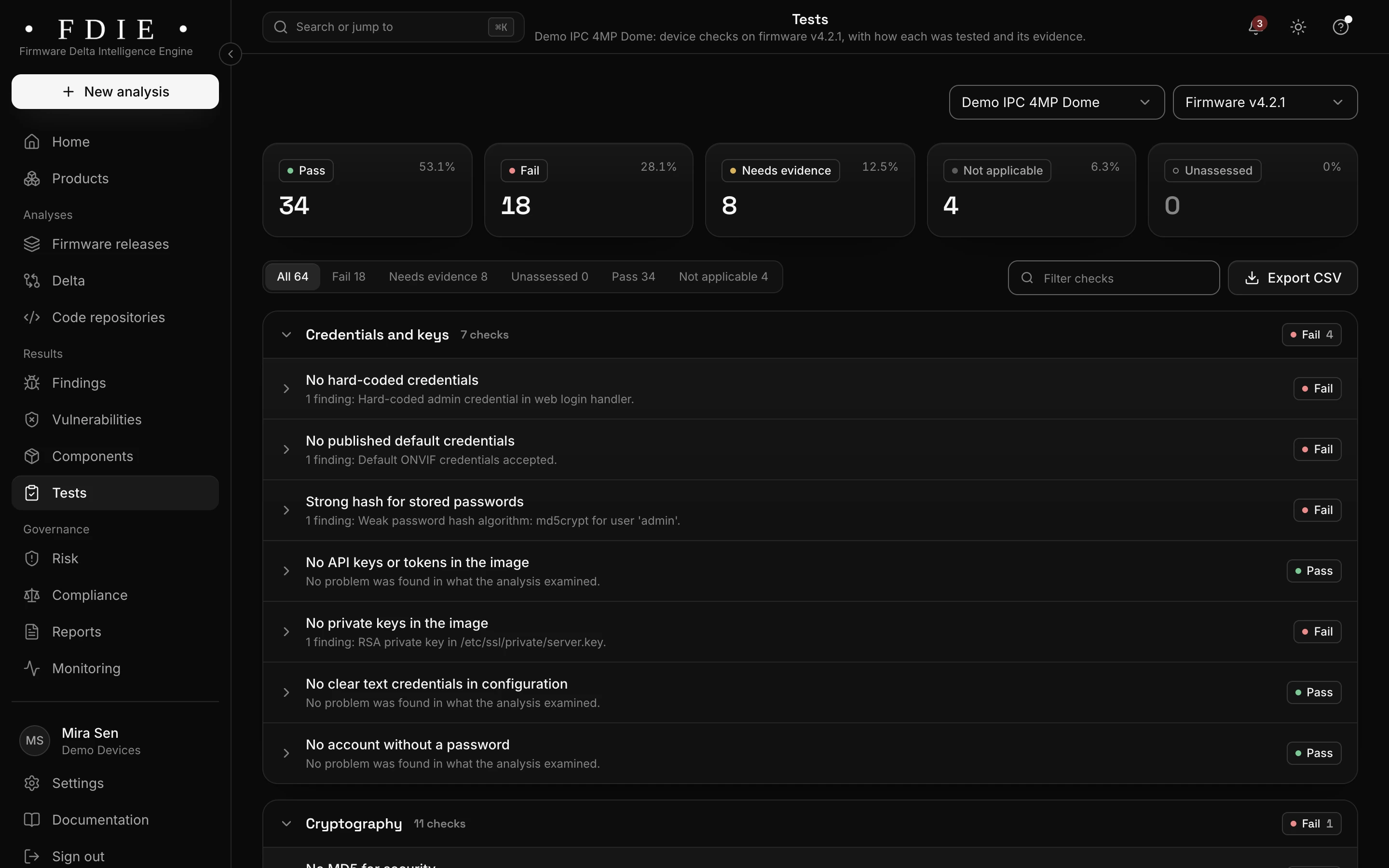
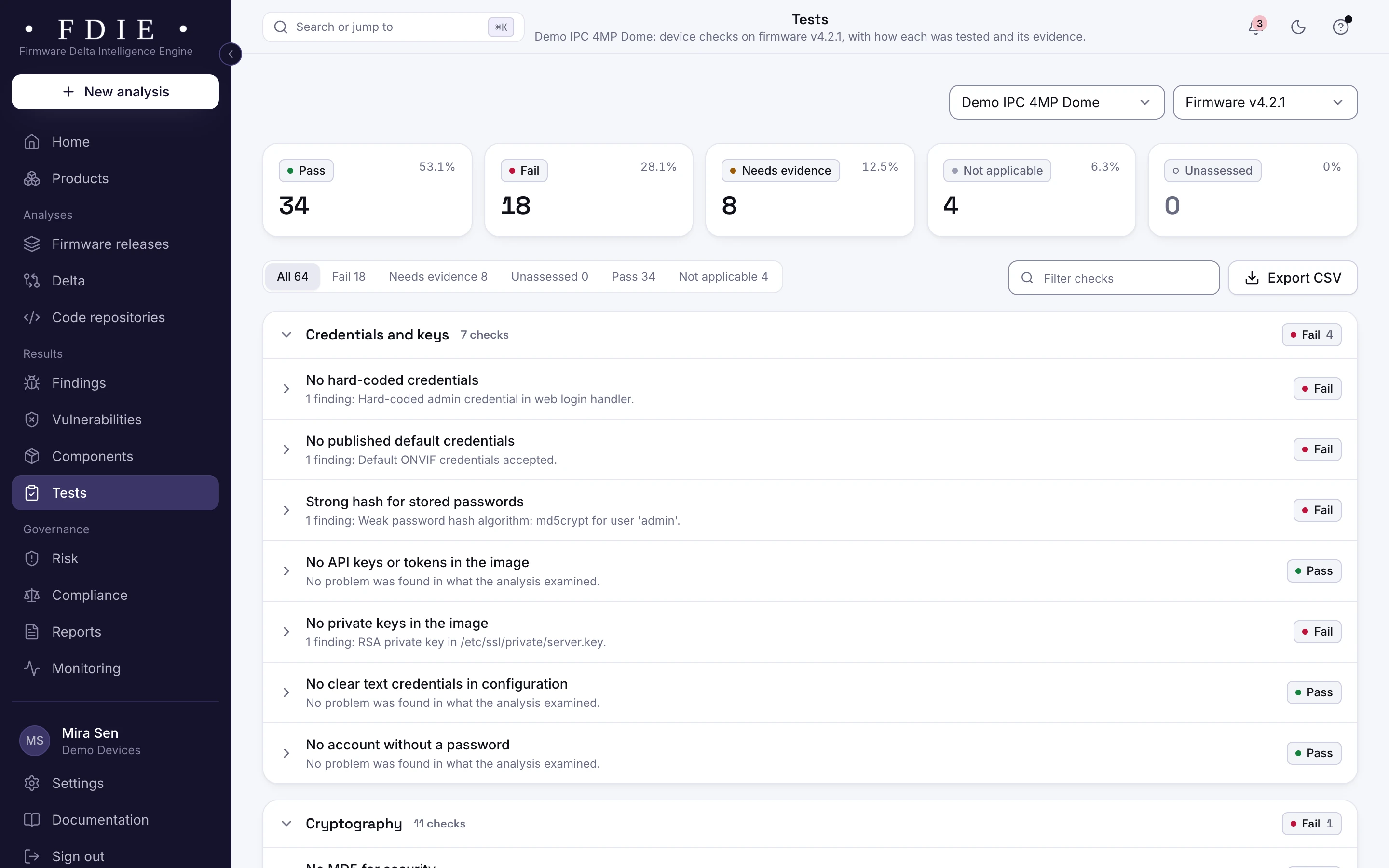
Device checks for one firmware release: all 64 checks counted as passed, failed, needs evidence, not applicable and unassessed, and the credentials and keys group with each check and what was found, for example a hard-coded admin credential, default ONVIF credentials and an MD5 crypt password hash.The same screen in the light theme.

Evidence for consumer device rules

For UK PSTI, the checks give evidence for no universal default passwords, and the disclosure policy and support period you record for the product cover the other two requirements. The same records feed ETSI EN 303 645, EN 18031 and, for products sold in the EU, the EU CRA.

  • UK PSTI's three requirements, with evidence for each
  • Your disclosure policy and support period, recorded once
  • Provisions the image cannot decide, marked for your evidence
Rules for the UK
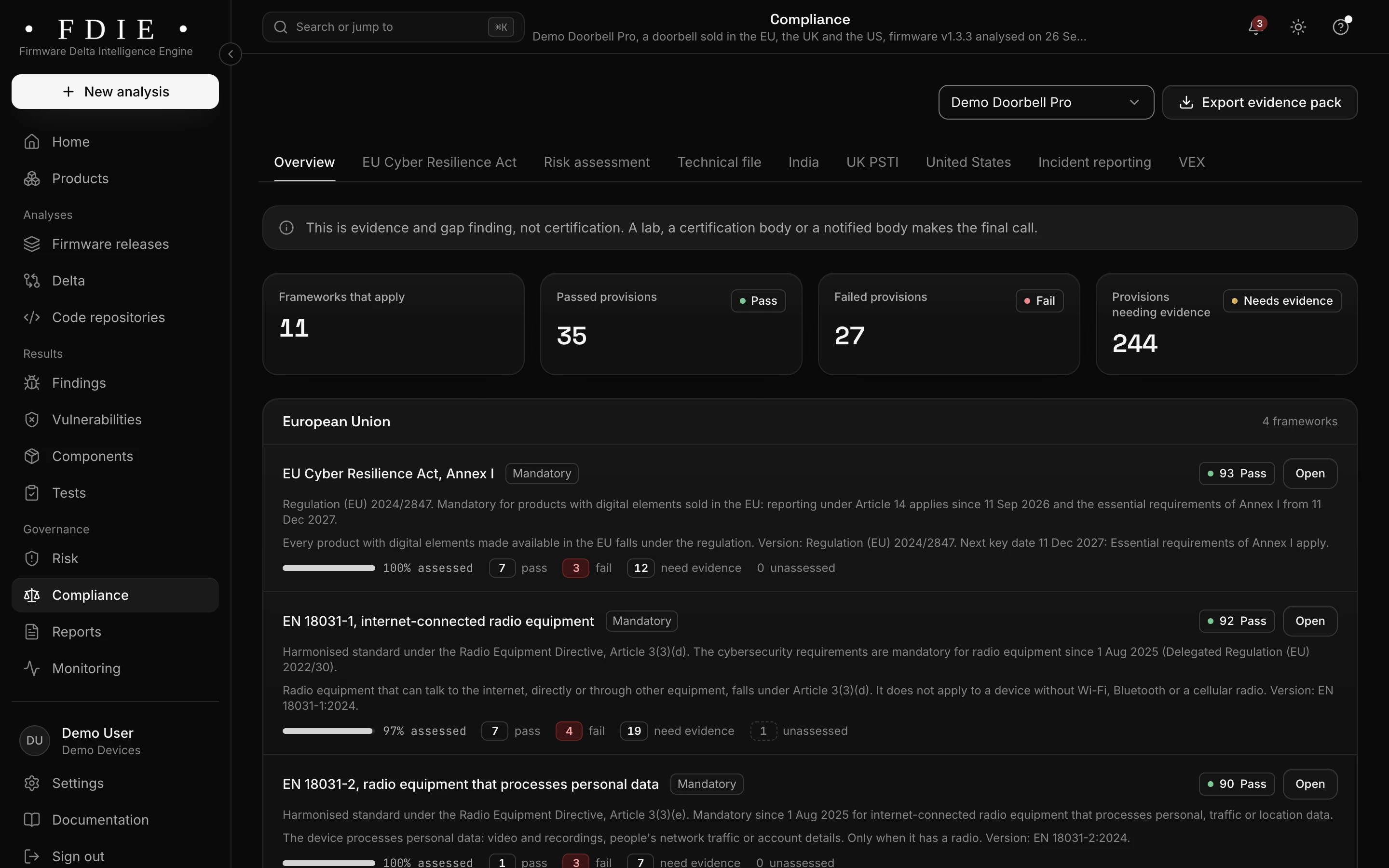
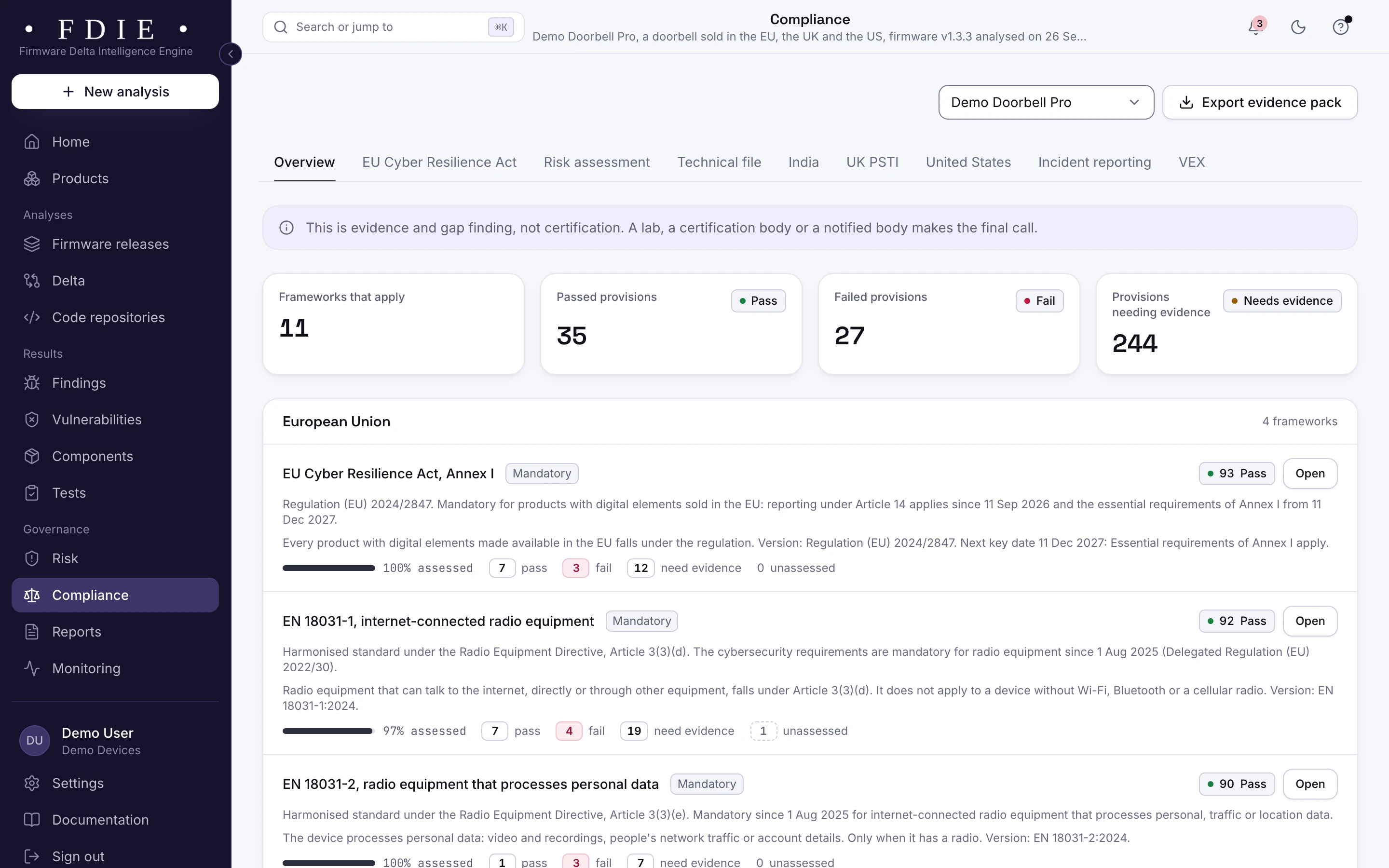
Compliance for a doorbell sold in the EU, the UK and the US: eleven frameworks apply, with the EU Cyber Resilience Act, EN 18031-1 and EN 18031-2 listed first, each with its pass, fail and need-evidence counts.The same screen in the light theme.

How it works

From firmware image to evidence in four steps

  1. 1

    Upload the firmware

    A Linux image or a microcontroller file such as Intel HEX, UF2 or an ESP image.

  2. 2

    Read and checked

    FDIE lays out the image, identifies its components and runs the device checks. With runtime evidence on, programs from the image also run under emulation in a separate isolated job.

  3. 3

    Record what the image cannot show

    Add the product's disclosure policy and support period once; they feed every market's evidence.

  4. 4

    Export and keep watching

    Export the evidence and reports, and get alerts for new flaws for as long as the product is supported.

Know the split

What the image shows, and what stays with the lab

FDIE analyses the firmware, not the device. Knowing the split tells you what to fix before the lab and what to prepare for it.

From the firmware image, in FDIE

  • Default passwords, keys and tokens in the image
  • Components and versions, in Linux and microcontroller images
  • The update path: signatures, encryption and rollback
  • Telnet, debug tools and serial shells set to start

On the device, with your testers or the lab

  • Pairing with the app and the cloud service
  • Bluetooth and Wi-Fi provisioning over the air
  • The companion app and cloud backend while they run
  • Penetration tests of the running device, and the test report

Rules by market

Rules this helps with

UK PSTI has applied to consumer connectable products sold in the UK since 29 April 2024. EN 18031 applies to radio equipment in the EU until the EU CRA applies in full on 11 December 2027. California and Oregon require reasonable security and unique passwords.

Compliance by market

India

  • TEC 31318

    Voluntary code for consumer IoT, Release 2.0 of November 2025

EU and UK

US

International

Evidence and gap finding, not certification: the lab or certification body decides.

Deliverables

What your team gets

  • PSTI evidence

    The three requirements, from the image and from what you record for the product.

  • Pre-certification report

    A signed PDF of checks, findings and fixes for the release.

  • SBOM

    Linux and microcontroller components in CycloneDX 1.6 or SPDX 2.3.

  • VEX statements

    Your answer when a vulnerability does not affect the device.

  • Alerts through the support period

    New flaws in the product's components, for as long as you support it.

  • Risk register

    Accepted risks with owners and due dates, each approved by a second person.

Questions

Does it read ESP32 firmware?

Yes. ESP32, ESP32-S2, ESP32-S3 and ESP8266 images on Xtensa, ESP32-C and ESP32-H images on RISC-V, and Cortex-M and other microcontrollers in Intel HEX, S-record, UF2 and DfuSe files.

Does it check UK PSTI?

It gives evidence for PSTI's requirements from the image and from what you record for the product, such as its disclosure policy and support period.

Do video doorbells get the camera checks?

Yes. When a doorbell's image carries stream or ONVIF software or a cloud P2P SDK, the camera checks apply, as they do for IP cameras.

Is the device itself tested?

No. FDIE analyses the firmware and, if you connect it, the source code. Pairing, radio and the running device stay with your testers.

What about the companion app and the cloud?

Connect their repositories and the code engine reads them too, with their findings beside the device's in the same product.

Find out what the lab would flag in your firmware

A 45-minute call with our team. Bring one firmware image.

Request access