Firmware security for industrial and OT devices

Industrial gateways, controllers and industrial PCs stay in service for many years, on PowerPC, ARM or x86, with an embedded Linux or an RTOS. Buyers increasingly ask for IEC 62443-4-2 evidence before they buy. FDIE reads the firmware you ship, finds what an assessor would question and shows which requirements the image can answer and which need your evidence.

Request access
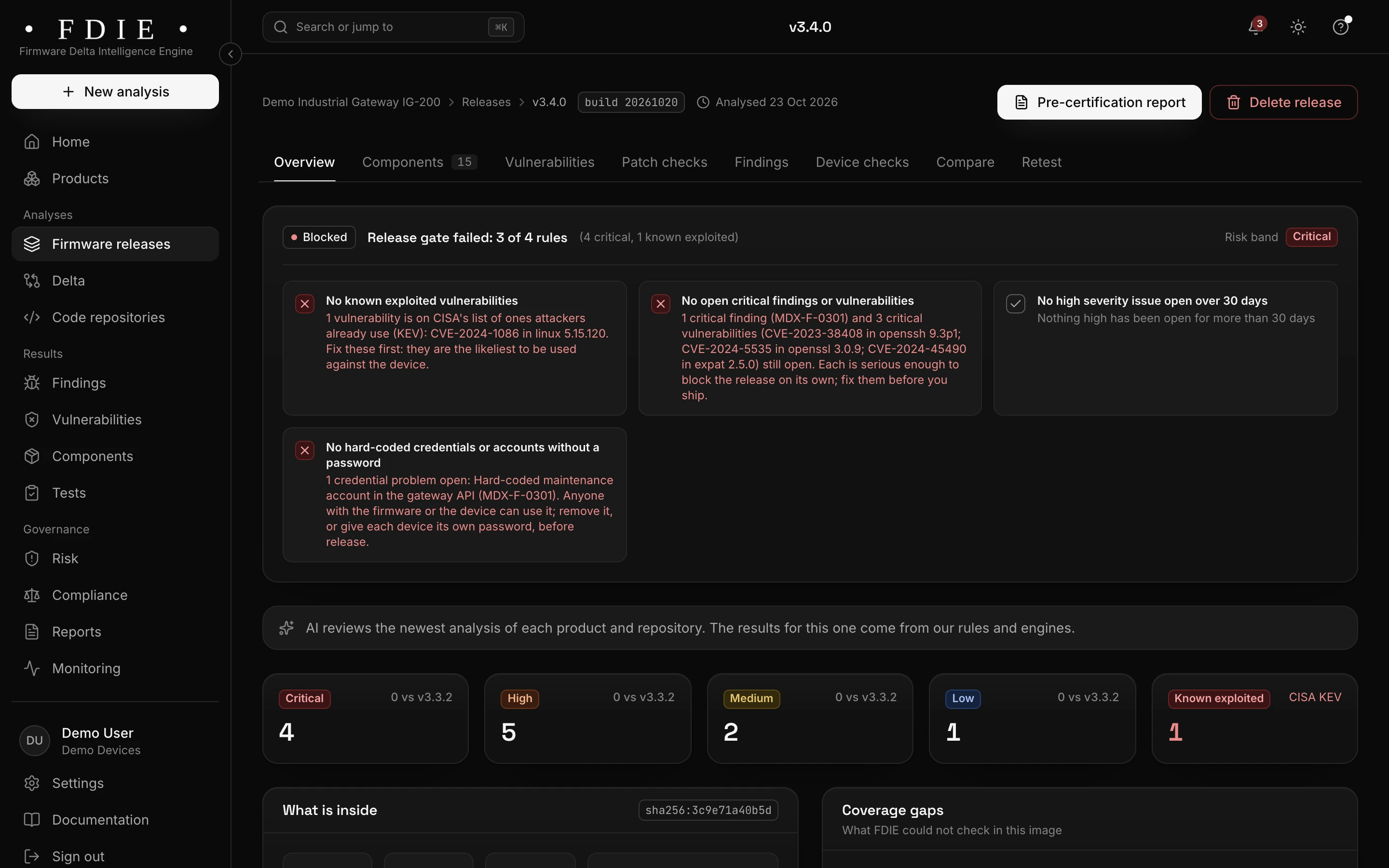
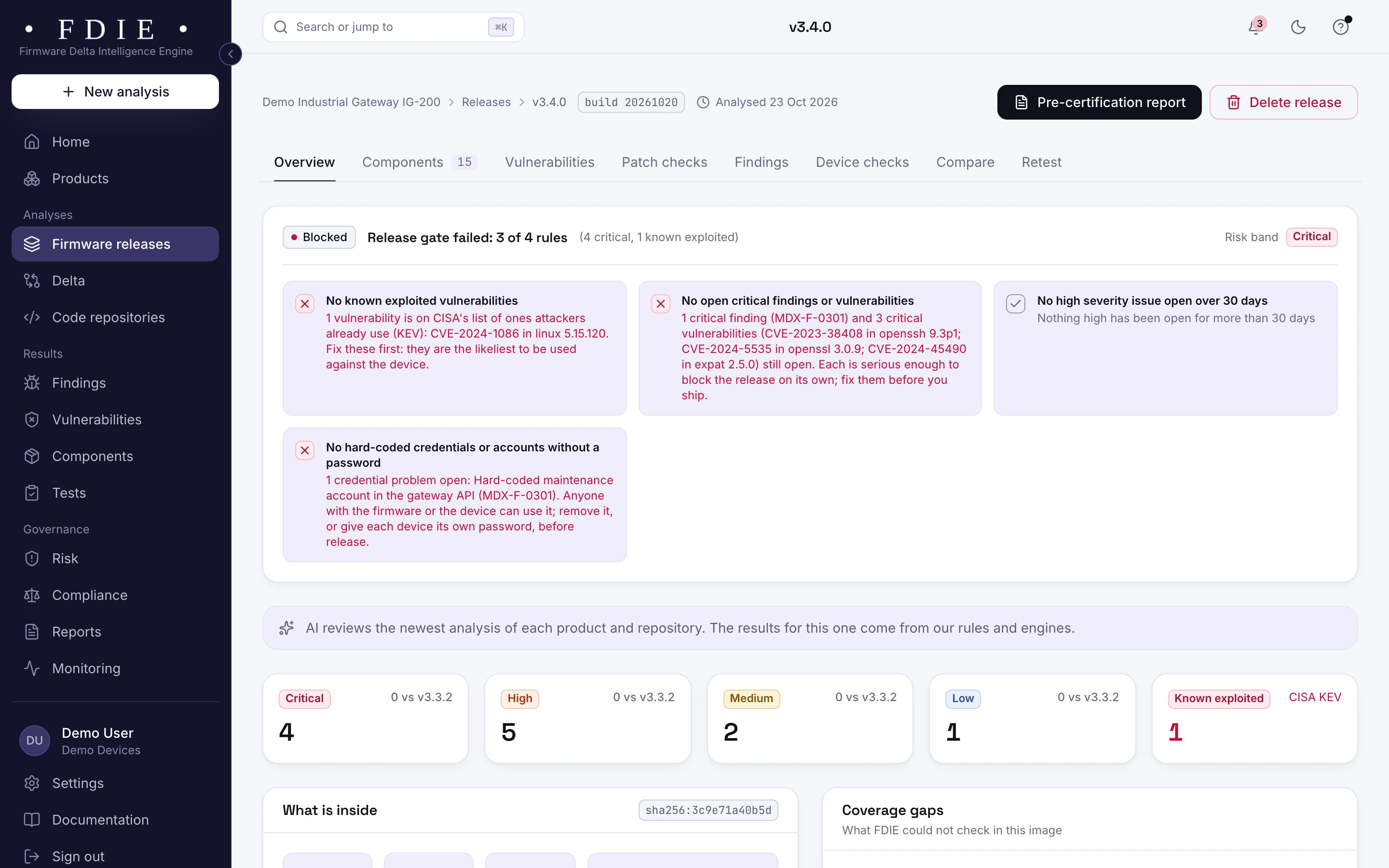
An industrial gateway release blocked by its release gate: a known exploited Linux kernel flaw, CVE-2024-1086, critical vulnerabilities in OpenSSH, OpenSSL and expat, and a hard-coded maintenance account in the gateway API.The same screen in the light theme.
An industrial gateway release from the app's sample organisation: the release gate held on a known exploited kernel flaw and a hard-coded maintenance account.

The challenge

Where industrial firmware goes wrong

  • Long lives, old components

    Industrial devices stay in the field far longer than consumer ones, and their Linux, OpenSSL and BusyBox versions age with them. Every year adds known vulnerabilities to a release nobody rebuilt.

  • Maintenance access left open

    Telnet, FTP, serial consoles and shared service accounts make field maintenance easy. They give an attacker on the plant network the same access.

  • Buyers ask for IEC 62443-4-2

    Operators and integrators ask component makers for evidence against IEC 62443-4-2 at a security level. Assembling it by hand for every release takes weeks.

How FDIE helps

What changes with FDIE

PowerPC, ARM and x86 images, read

FDIE unpacks embedded Linux images such as SquashFS, UBIFS and ext4, and disassembles ELF programs for PowerPC, ARM, AArch64, MIPS and x86. Raw MIPS builds of eCos, VxWorks and other RTOSes are read too, and whatever cannot be read is listed as a coverage gap.

  • Components with versions, licences and known vulnerabilities
  • Known exploited flaws from CISA KEV first
  • An SBOM in CycloneDX 1.6 or SPDX 2.3 for your buyers
How an image is read
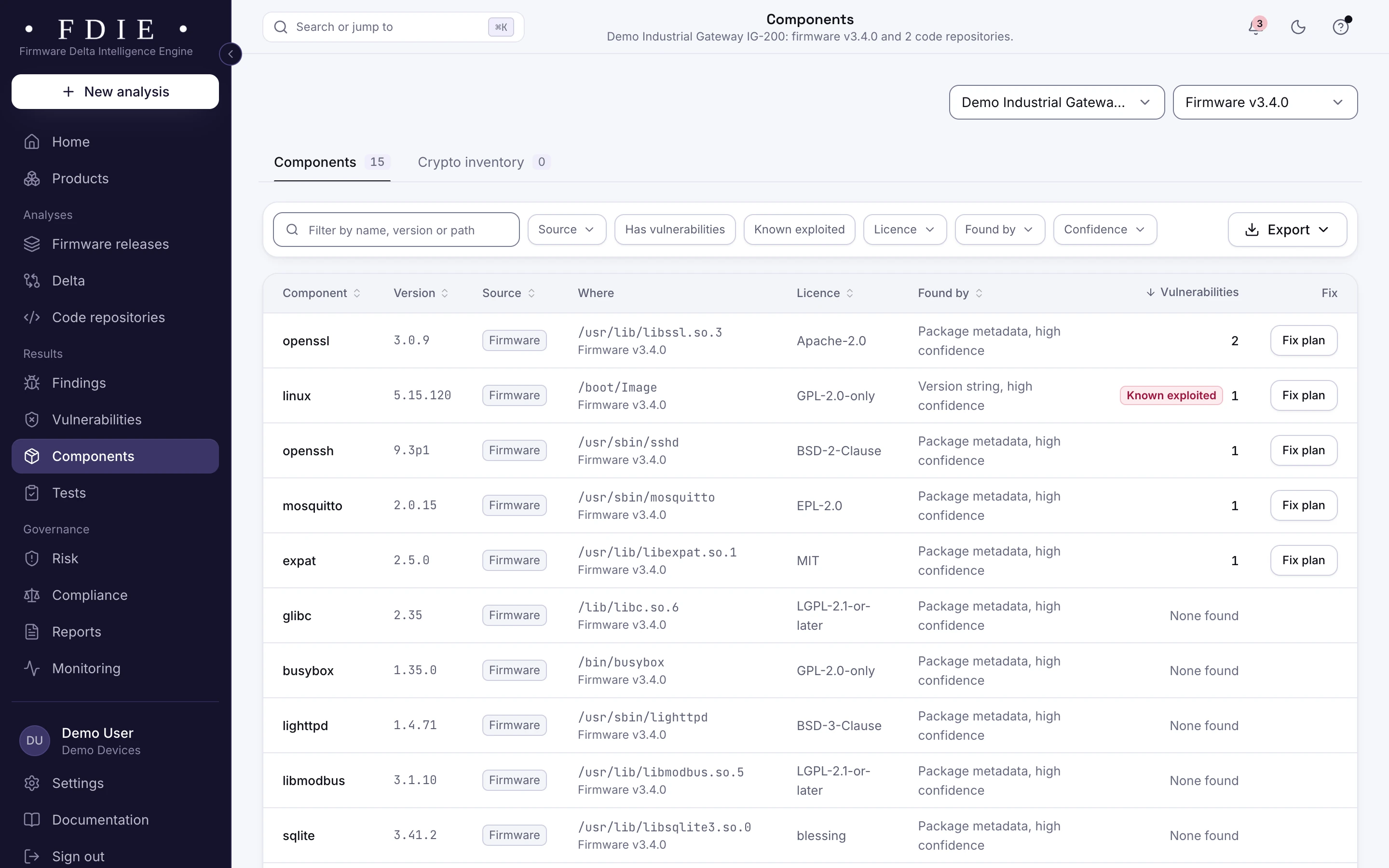
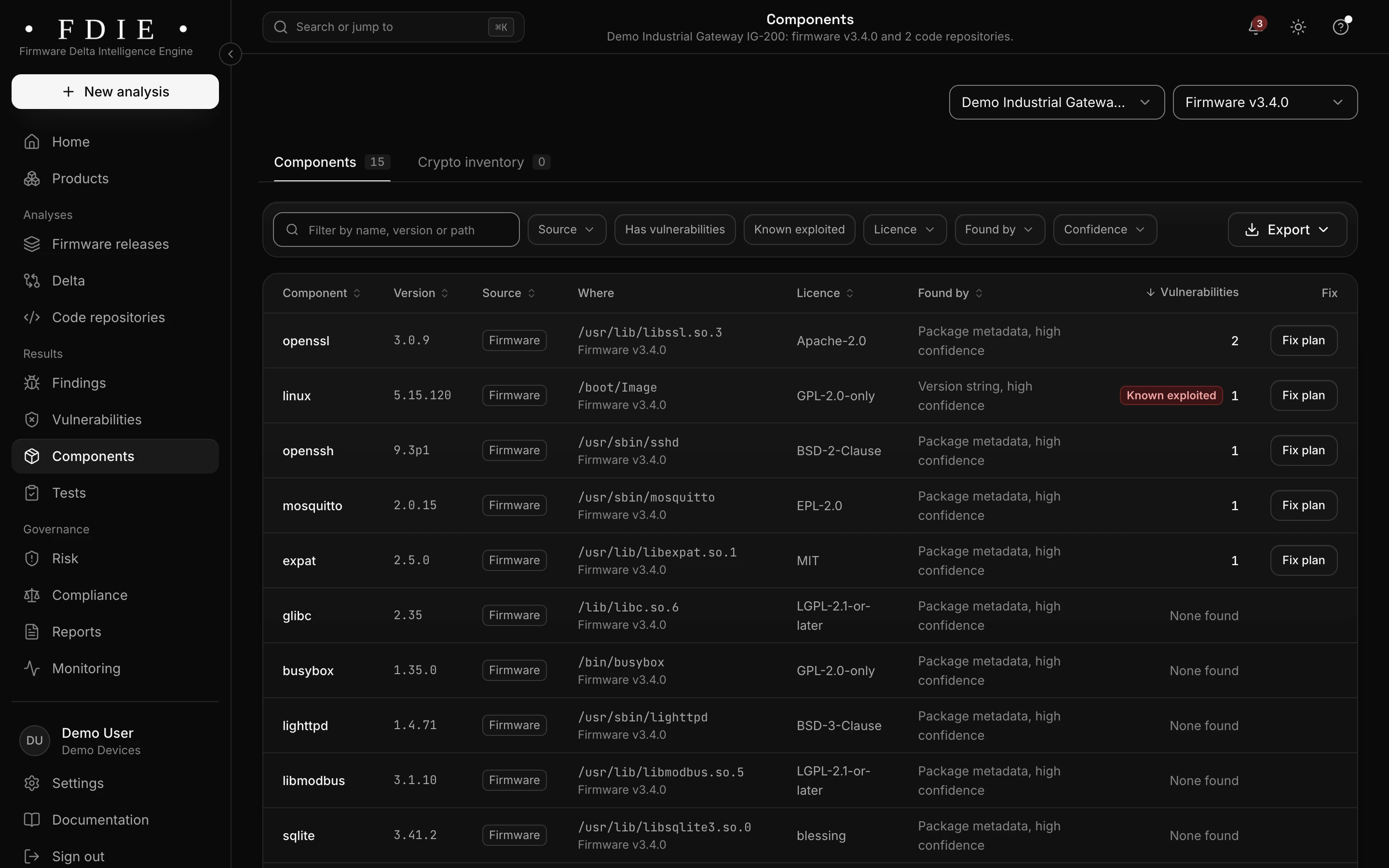
The gateway's components found in the image: OpenSSL, the Linux kernel marked known exploited, OpenSSH, Mosquitto, expat, glibc, BusyBox, lighttpd, libmodbus and SQLite, each with its file path, licence and vulnerability count.The same screen in the light theme.

Accounts, services and maintenance access

Device checks look for hard-coded and default accounts, accounts without a password, extra root accounts, telnet and FTP left on, services the product does not need, shells on the serial console and a web server running as root. Evidence is masked, so a password never shows in full.

  • Default and shared accounts, with the file they sit in
  • Telnet, FTP, SNMP and other unneeded services flagged
  • Serial console shells and debug tools set to start
How device checks work
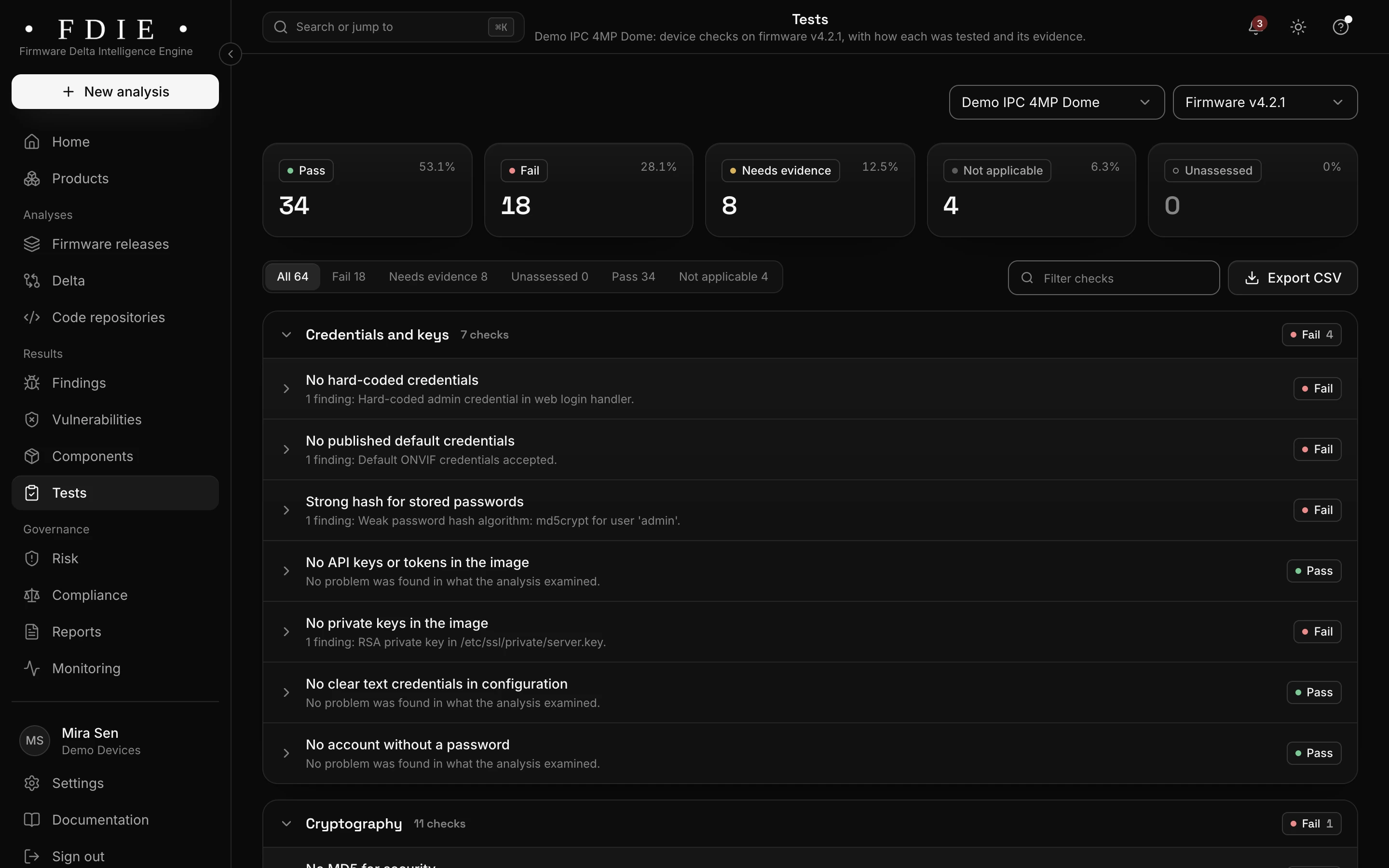
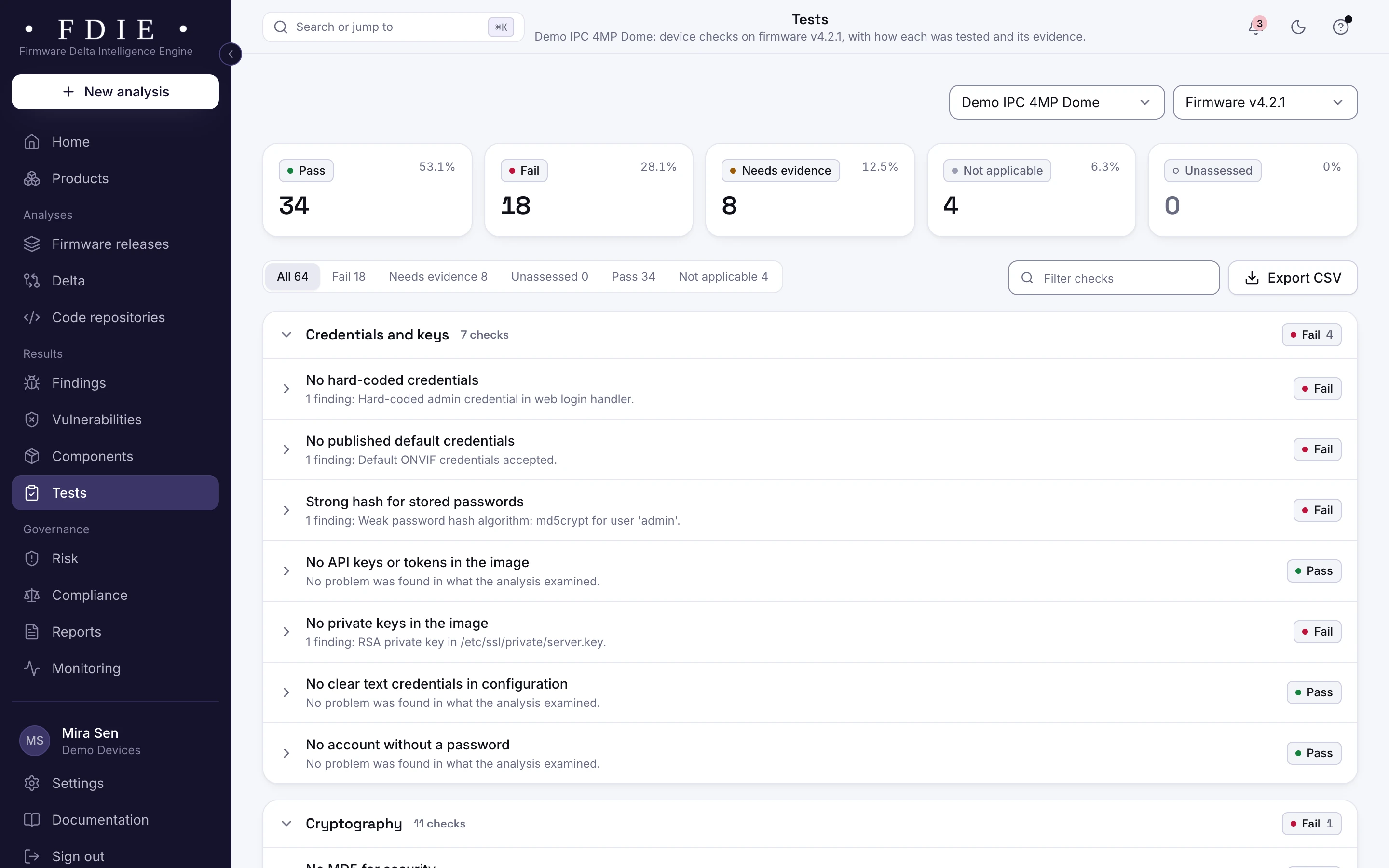
Device checks for one firmware release: all 64 checks counted as passed, failed, needs evidence, not applicable and unassessed, and the credentials and keys group with each check and what was found, for example a hard-coded admin credential, default ONVIF credentials and an MD5 crypt password hash.The same screen in the light theme.

Updates, boot and the build

Checks read the update path and the boot chain: signed updates, encrypted downloads, rollback protection, signature checks in the boot loader and integrity checks at boot. With the source connected, rules read Yocto and BitBake recipes, Kconfig and build flags for telnet servers, root without a password and hardening turned off.

  • Signed updates and rollback protection checked
  • Boot loader signatures and integrity at boot
  • Yocto recipes and build settings read as firmware code
Build configuration rules
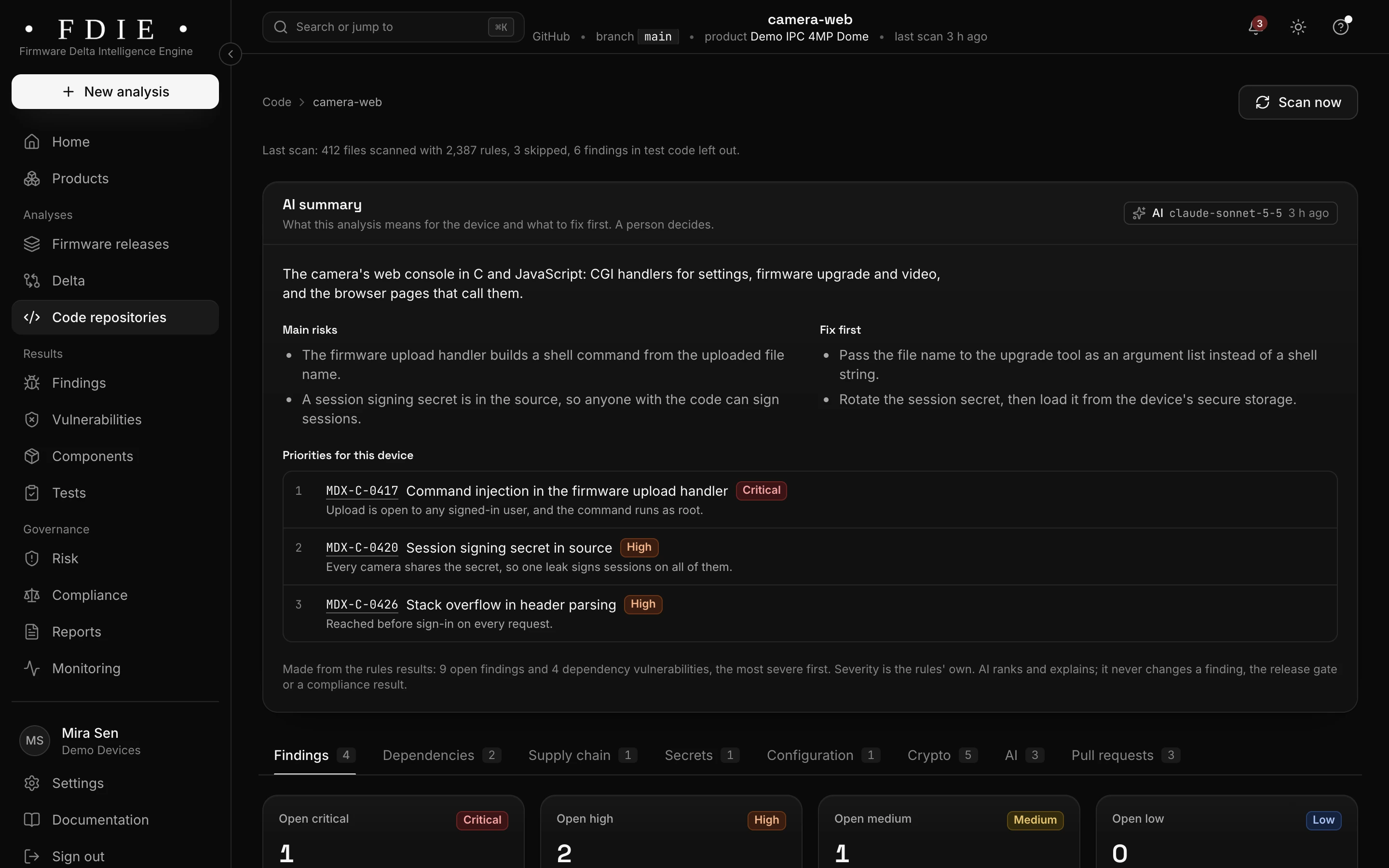
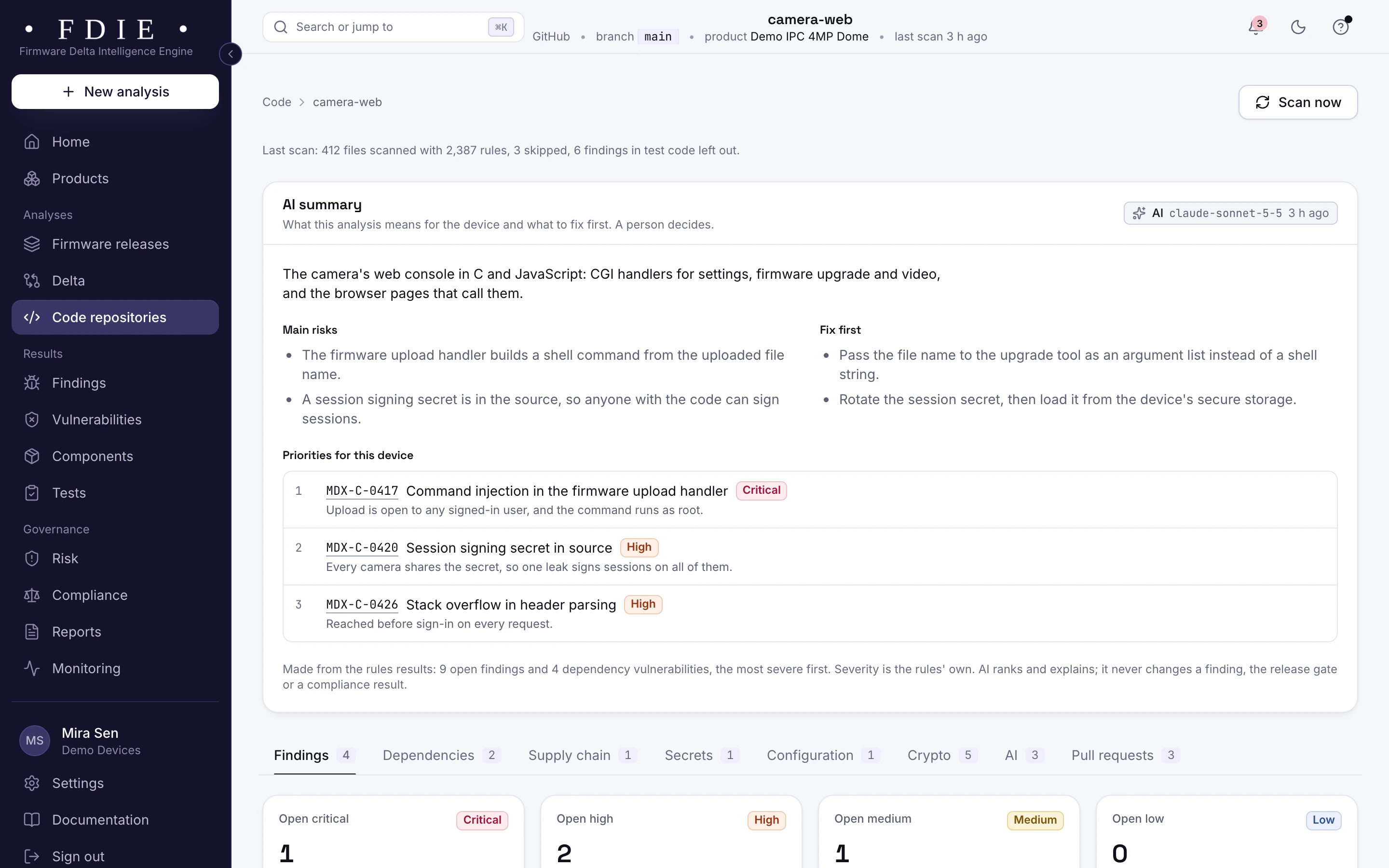
A connected GitHub repository for the camera's web interface: the AI summary of its main risks and what to fix first, three priorities (command injection in the firmware upload handler, a session signing secret in source and a stack overflow in header parsing), and tabs for findings, dependencies, supply chain, secrets, configuration, crypto, AI and pull requests.The same screen in the light theme.

Evidence for IEC 62443-4-2

The app holds IEC 62443-4-2 as a framework. Device checks give part of the evidence for requirements such as human user identification and authentication, authenticator management, unsuccessful login attempts, software and information integrity and input validation. The others, such as session control, timestamps and backup, are marked for your evidence at the security level you claim.

  • Each requirement helped by the checks or left to you
  • Your own evidence kept with the release
  • An evidence pack for the integrator or operator
International standards
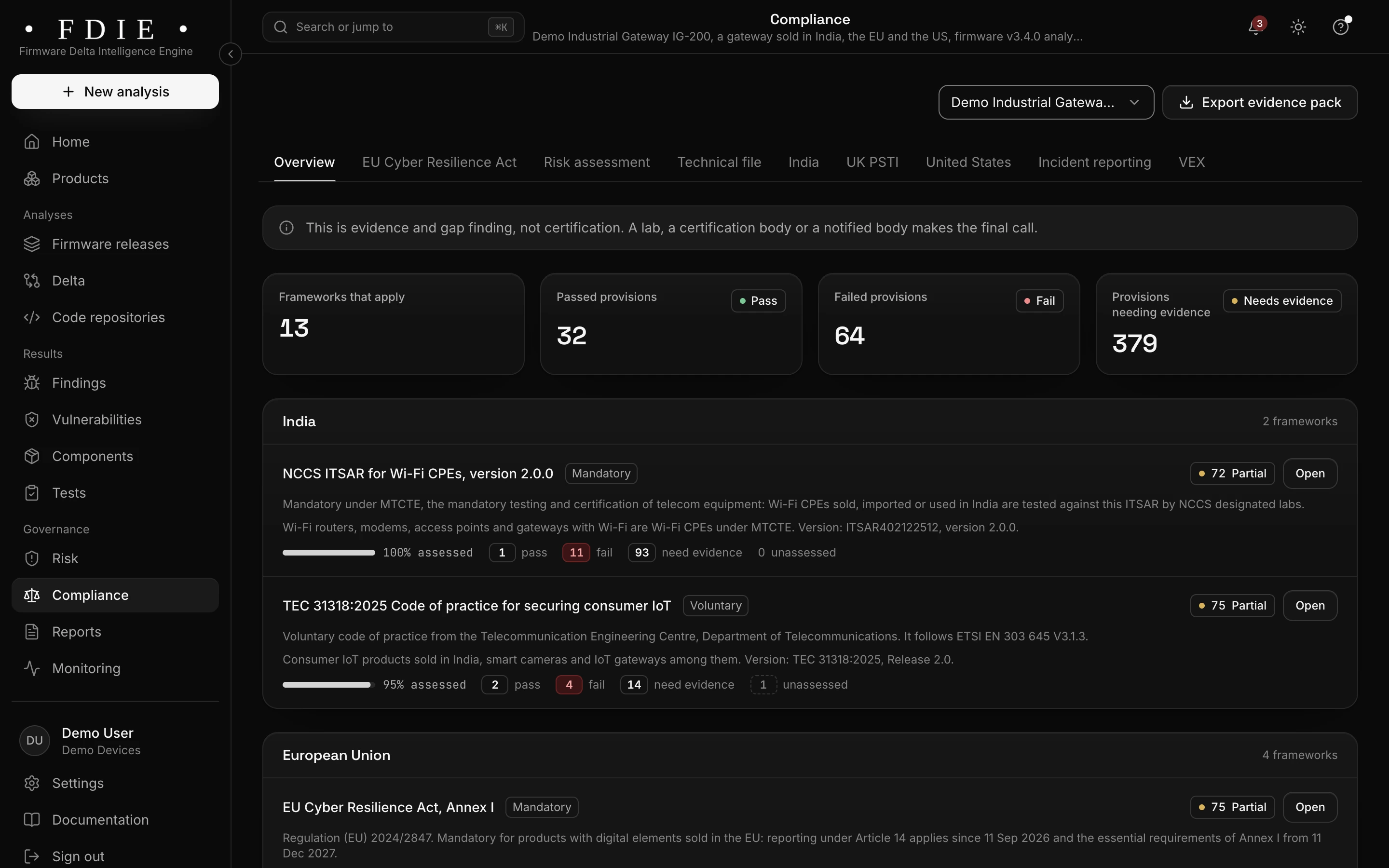
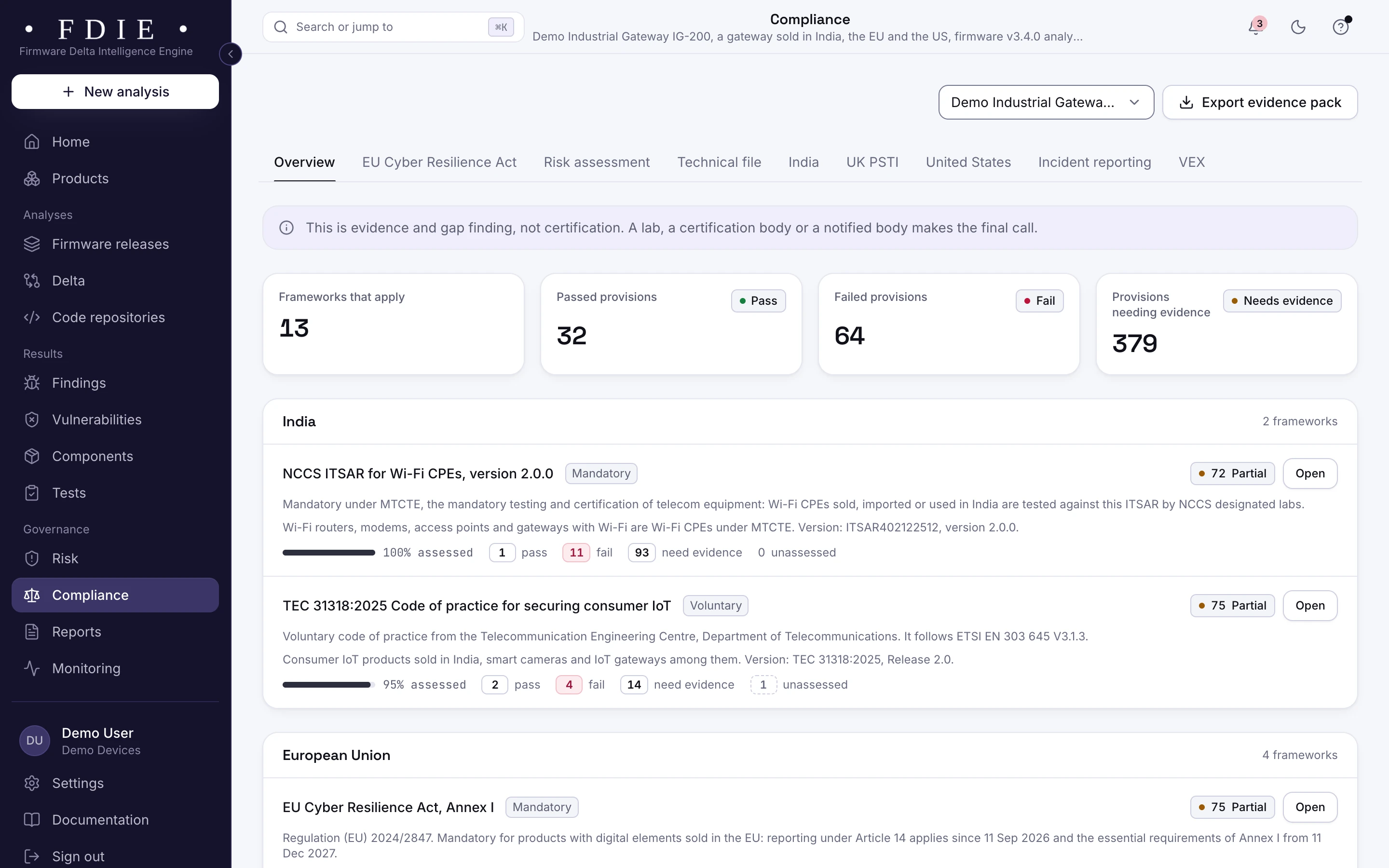
Compliance for an industrial gateway sold in India, the EU and the US: thirteen frameworks apply, starting with NCCS ITSAR for Wi-Fi CPEs and TEC 31318, each with its pass, fail and need-evidence counts.The same screen in the light theme.

How it works

From firmware image to evidence in four steps

  1. 1

    Upload the gateway or controller build

    Upload the firmware image, import it from a GitHub or GitLab release, or let CI send each build.

  2. 2

    Read and checked

    FDIE unpacks the image, disassembles the programs and runs the device checks. Nothing touches your plant: with runtime evidence on, programs from the image run only under emulation in a separate isolated job.

  3. 3

    Fix and record

    Fix default accounts, open services and exploited flaws first, and attach evidence for the requirements the image cannot answer.

  4. 4

    Hand over the evidence

    Export the SBOM, the evidence pack and signed reports, and keep the release monitored for as long as you support it.

Know the split

What the image shows, and what stays with the lab

FDIE analyses the firmware, not the device. Knowing the split tells you what to fix before the lab and what to prepare for it.

From the firmware image, in FDIE

  • Components, their versions and known vulnerabilities
  • Default and shared accounts, keys and tokens
  • Telnet, FTP, serial shells and unneeded services set to start
  • Update signatures, rollback protection and boot integrity
  • Binary hardening and weak cryptography

On the device, with your testers or the lab

  • Tests of the running device and its industrial protocols
  • Network segmentation and the system around the device
  • Denial of service and resilience tests
  • The IEC 62443 assessment and any certificate

Rules by market

Rules this helps with

IEC 62443-4-2 is voluntary, and buyers of industrial gateways and controllers often ask for it. For products sold in the EU, the EU CRA covers industrial products with digital elements too, and EN 18031 applies to internet-connected radio equipment.

Compliance by market

EU and UK

US

International

Evidence and gap finding, not certification: the lab or certification body decides.

Deliverables

What your team gets

  • IEC 62443-4-2 evidence

    Requirements helped by the checks, and those left to you, with the evidence behind each.

  • SBOM

    Every component in CycloneDX 1.6 or SPDX 2.3, for operators and integrators.

  • Pre-certification report

    A signed PDF of checks, findings and fixes for the release.

  • VEX statements

    Your team's reasons a vulnerability does not affect the device.

  • Alerts for the long haul

    New flaws in a supported product's components, for as long as its support period runs.

  • Risk register

    Accepted risks with owners and due dates, each approved by a second person.

Questions

Does FDIE connect to our plant network?

No. It analyses the firmware image you upload. Nothing is scanned on your network, and with runtime evidence on, programs from the image run only under emulation in a separate isolated job, with the firmware's own network refused.

Which processors does it read?

ELF programs for PowerPC, ARM, AArch64, MIPS and x86, raw MIPS builds of RTOSes such as eCos and VxWorks, and microcontroller images in Intel HEX and S-record files. What it cannot read is listed as a coverage gap.

Does it decide our IEC 62443-4-2 security level?

No. The device checks give part of the evidence for some requirements; the security level and most requirements need your evidence and an assessor.

What about industrial PCs with UEFI?

UEFI firmware volumes and capsules are read too, with Secure Boot checks for test keys and the revocation list. The PCs and servers page has the detail.

Can it read our Yocto build?

Yes, when you connect the repository. Rules read BitBake recipes, layers and image configuration for checksums not enforced, unverified fetches, telnet or rsh servers, remote debugging agents and root without a password.

Find out what the lab would flag in your firmware

A 45-minute call with our team. Bring one firmware image.

Request access