Firmware security for routers and gateways

Router and gateway firmware carries a Linux system, a web admin interface, CGI scripts and a long list of network services, often from a chip vendor's SDK or OpenWrt. Operators, ITSAR labs in India and EN 18031 in the EU look at exactly these. FDIE shows you what they will find, from the image and from your source.

Request access
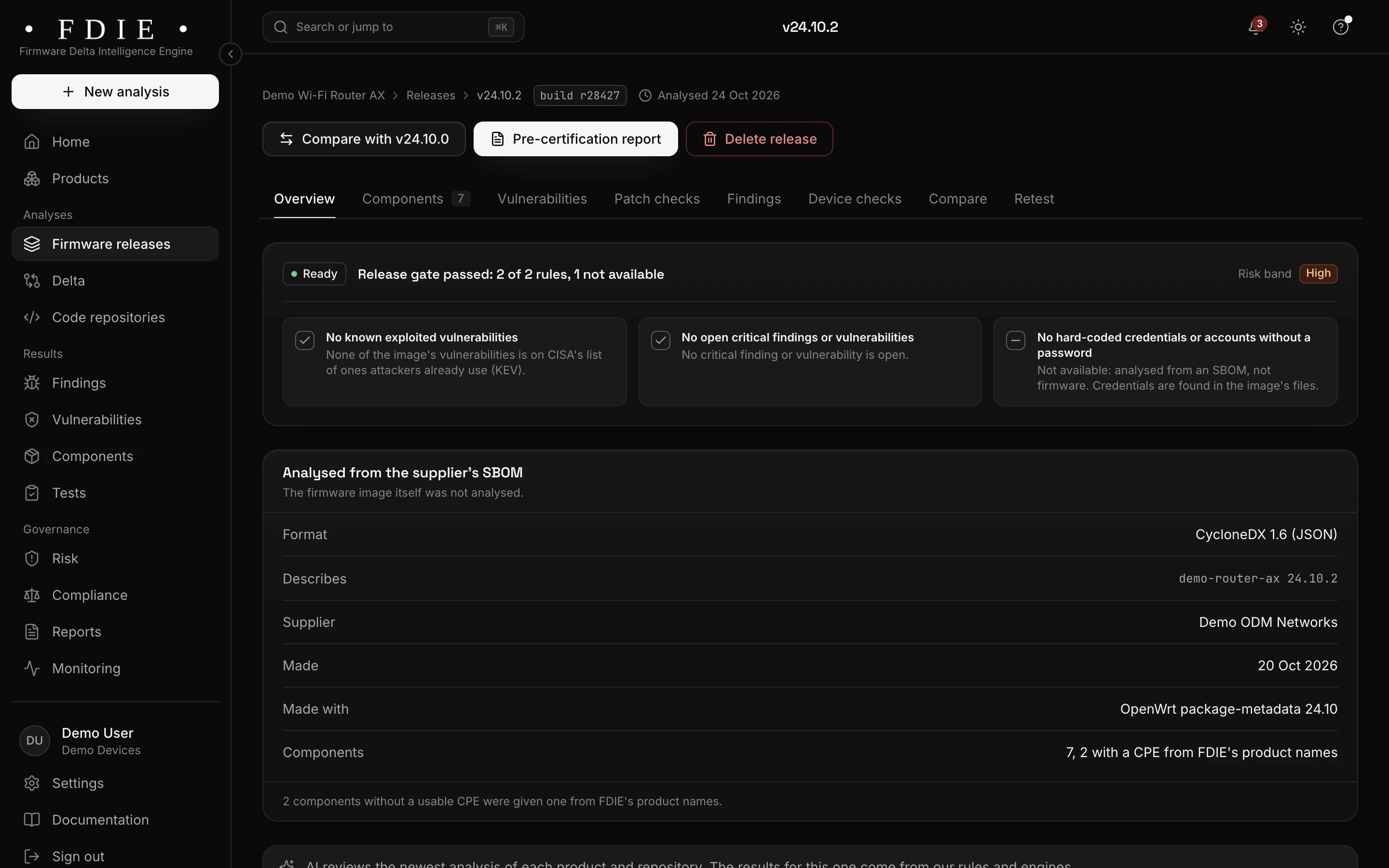
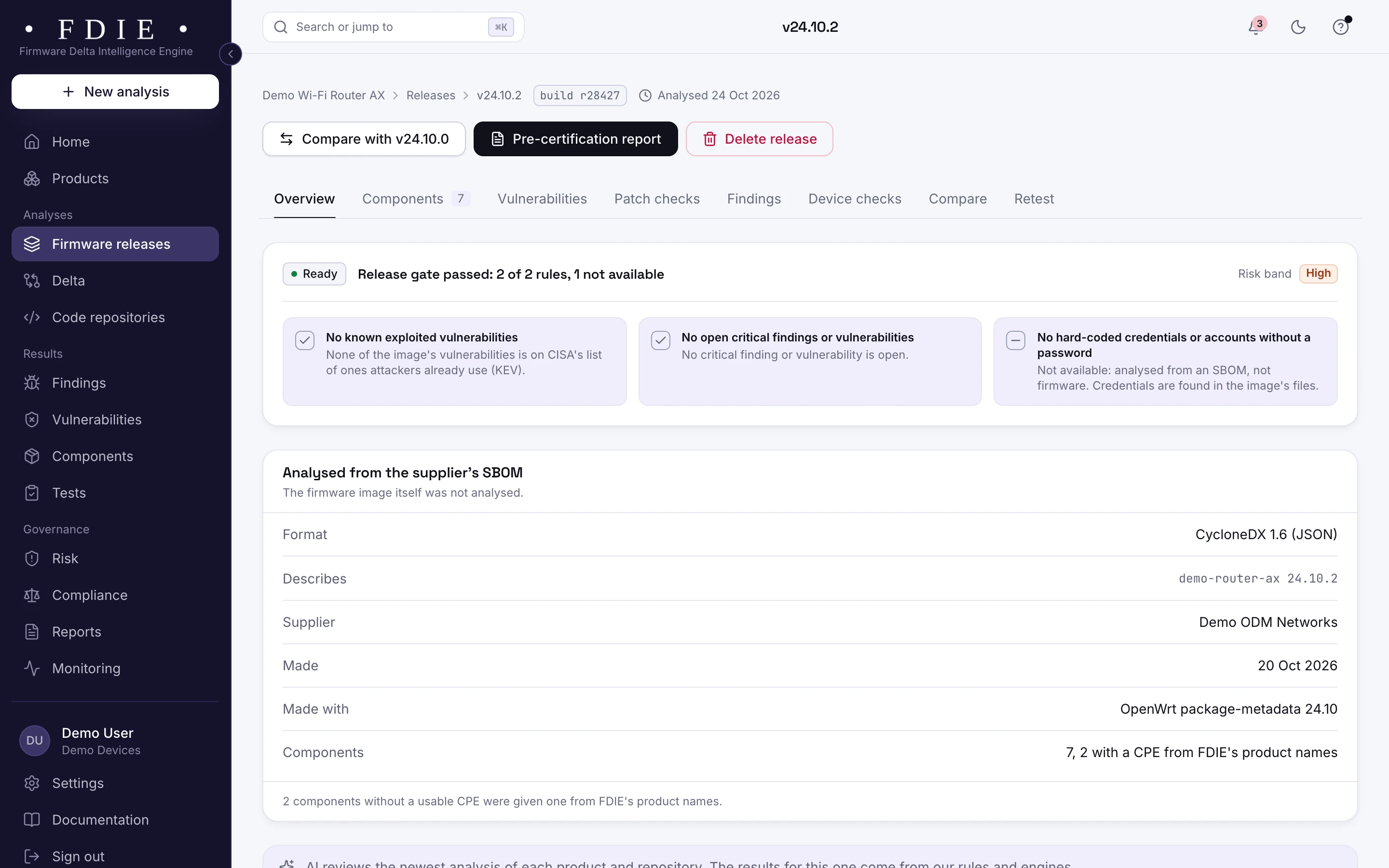
A router release analysed from the supplier's SBOM, a CycloneDX 1.6 file from the ODM: the release gate passed on 2 of 2 rules, with the credentials rule not available because no image was analysed, and the SBOM's format, supplier, tool and seven components.The same screen in the light theme.
A router release analysed from the supplier's SBOM, from the app's sample organisation: the release gate and the SBOM's supplier, format and components.

The challenge

Where router firmware goes wrong

  • Every service is a door

    Telnet, UPnP, TR-069 remote management, SNMP and the web admin page all listen on the network. Services the product does not need are the first thing attackers and labs look for.

  • The web admin interface

    CGI scripts and Lua or LuCI handlers pass form fields to shell commands. Command injection in these handlers is behind many published router flaws.

  • Operators and certification want evidence

    Operators ask for an SBOM and test results before they deploy a model, and in India ITSAR certification is mandatory for IP routers and Wi-Fi CPE. Both take time you do not have at the end of a project.

How FDIE helps

What changes with FDIE

OpenWrt and SDK images, unpacked

SquashFS, UBIFS and vendor wrappers such as TRX and uImage are read with FDIE's own readers, and file systems behind Seama, Netgear CHK and TP-Link headers are found. Programs for MIPS, ARM and AArch64 are disassembled, and components come with their versions and known vulnerabilities.

  • Vendor headers removed before the file system is read
  • Known exploited flaws from CISA KEV first
  • An SBOM operators can load into their own tools
How an image is read
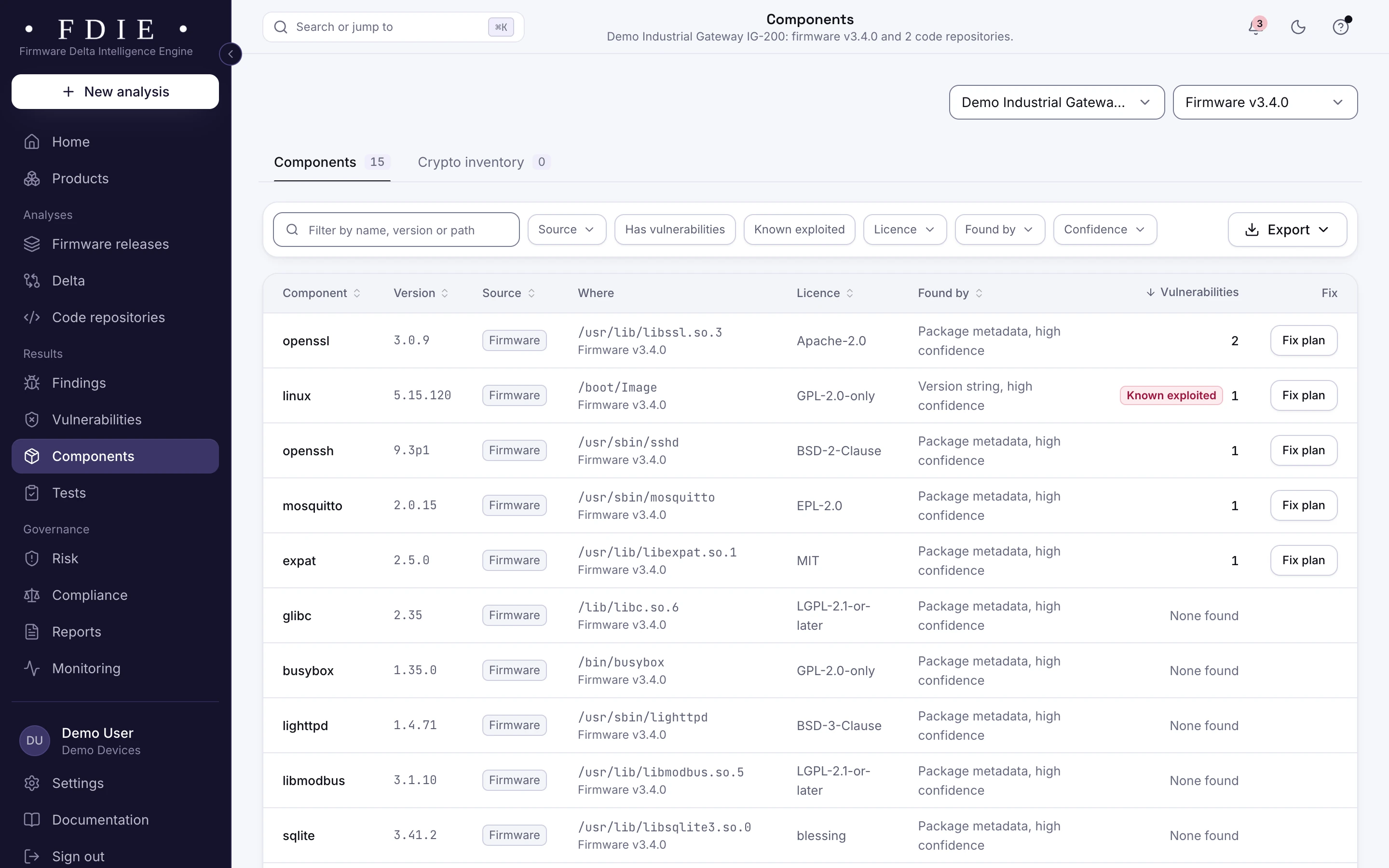
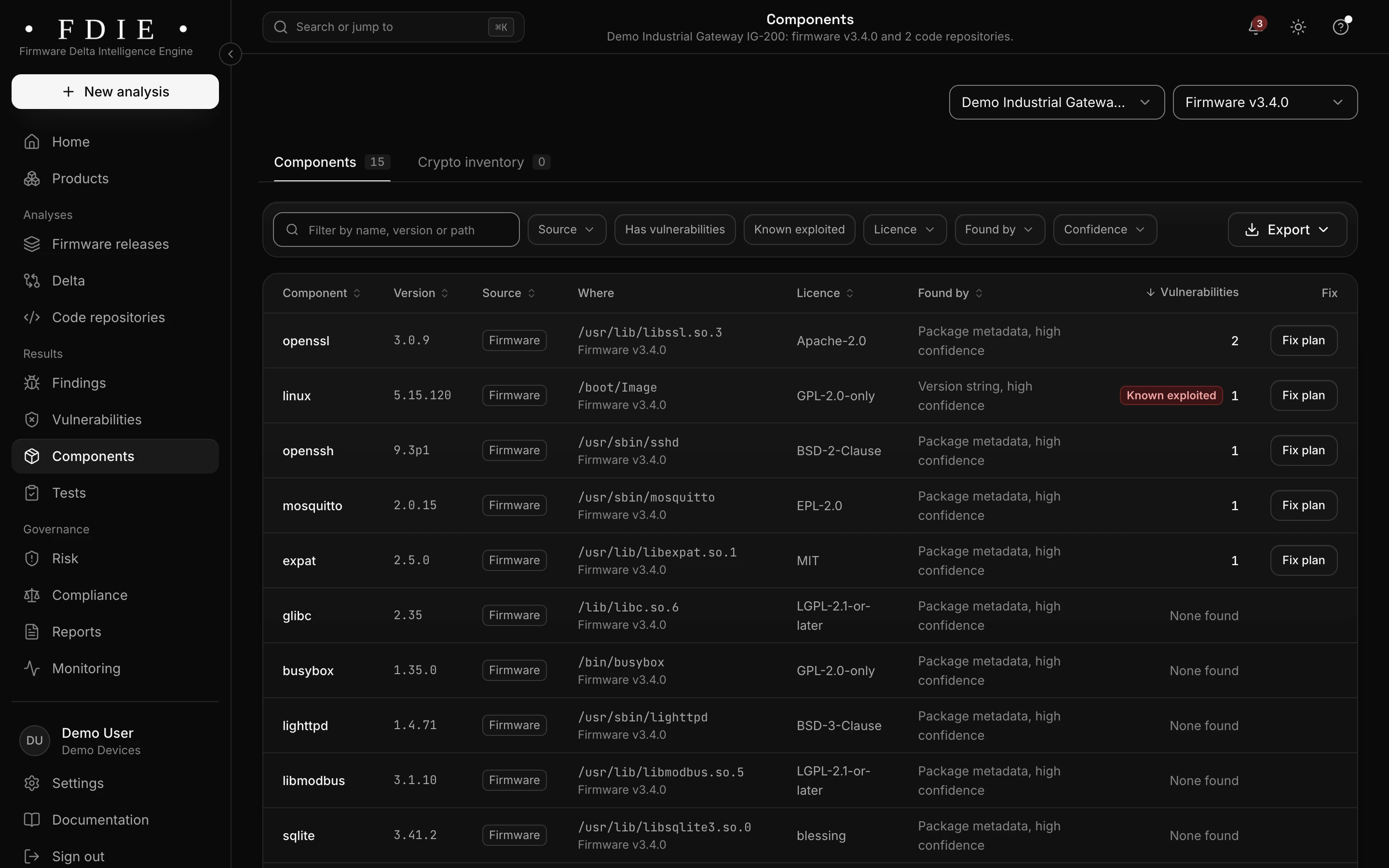
The gateway's components found in the image: OpenSSL, the Linux kernel marked known exploited, OpenSSH, Mosquitto, expat, glibc, BusyBox, lighttpd, libmodbus and SQLite, each with its file path, licence and vulnerability count.The same screen in the light theme.

Services and settings, checked

Device checks read init scripts, configuration and the programs present: telnet and FTP left on, services the product does not need, a web server running as root, management over plain HTTP, product details before sign-in and no brute-force protection. With the source or build tree connected, rules also read OpenWrt UCI, Dropbear, dnsmasq and firewall settings.

  • Telnet, FTP and unneeded services such as UPnP and SNMP flagged
  • Management over HTTPS and sign-in protection checked
  • Open UPnP, WAN input accepted and weak Wi-Fi in shipped OpenWrt settings
How device checks work
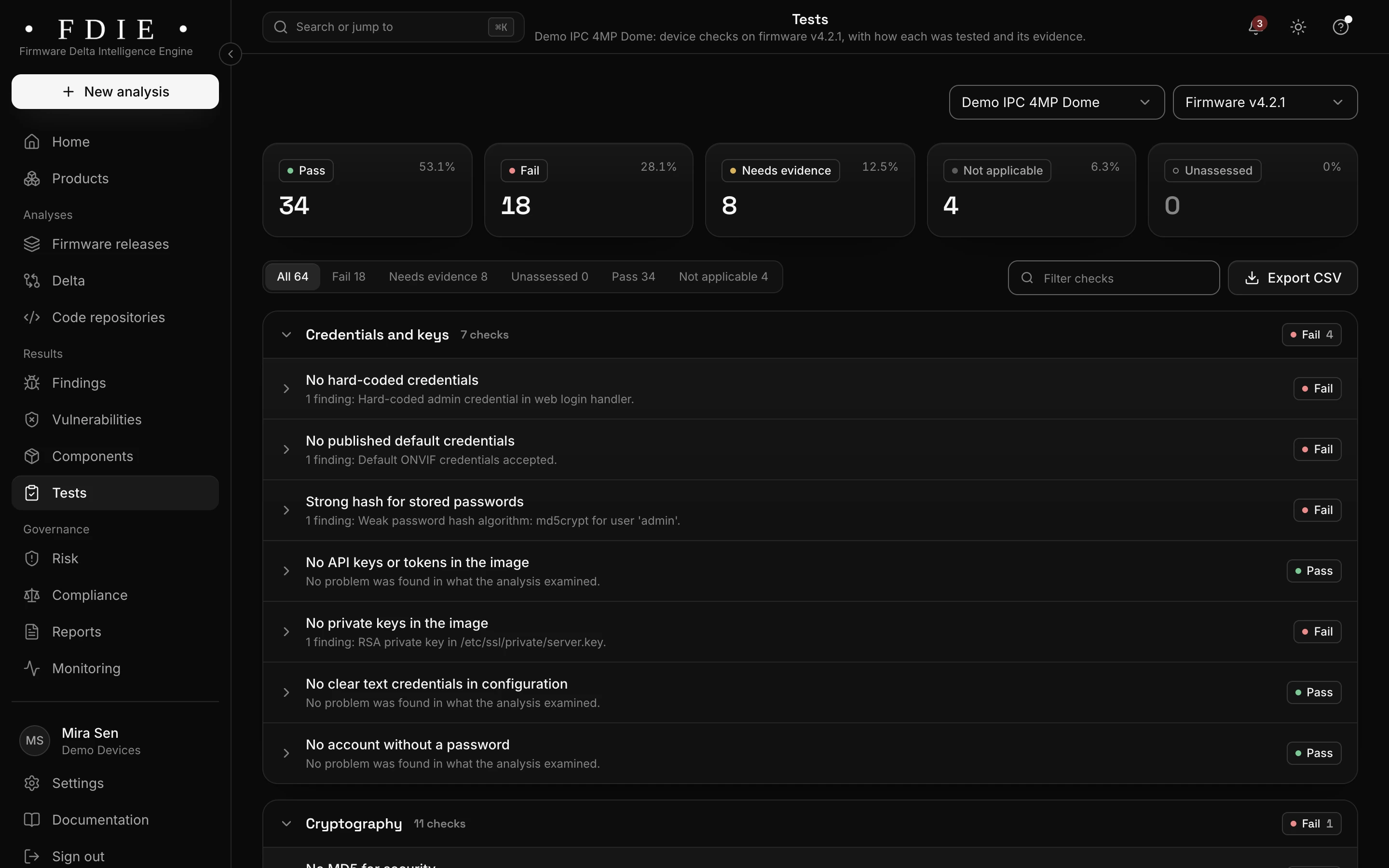
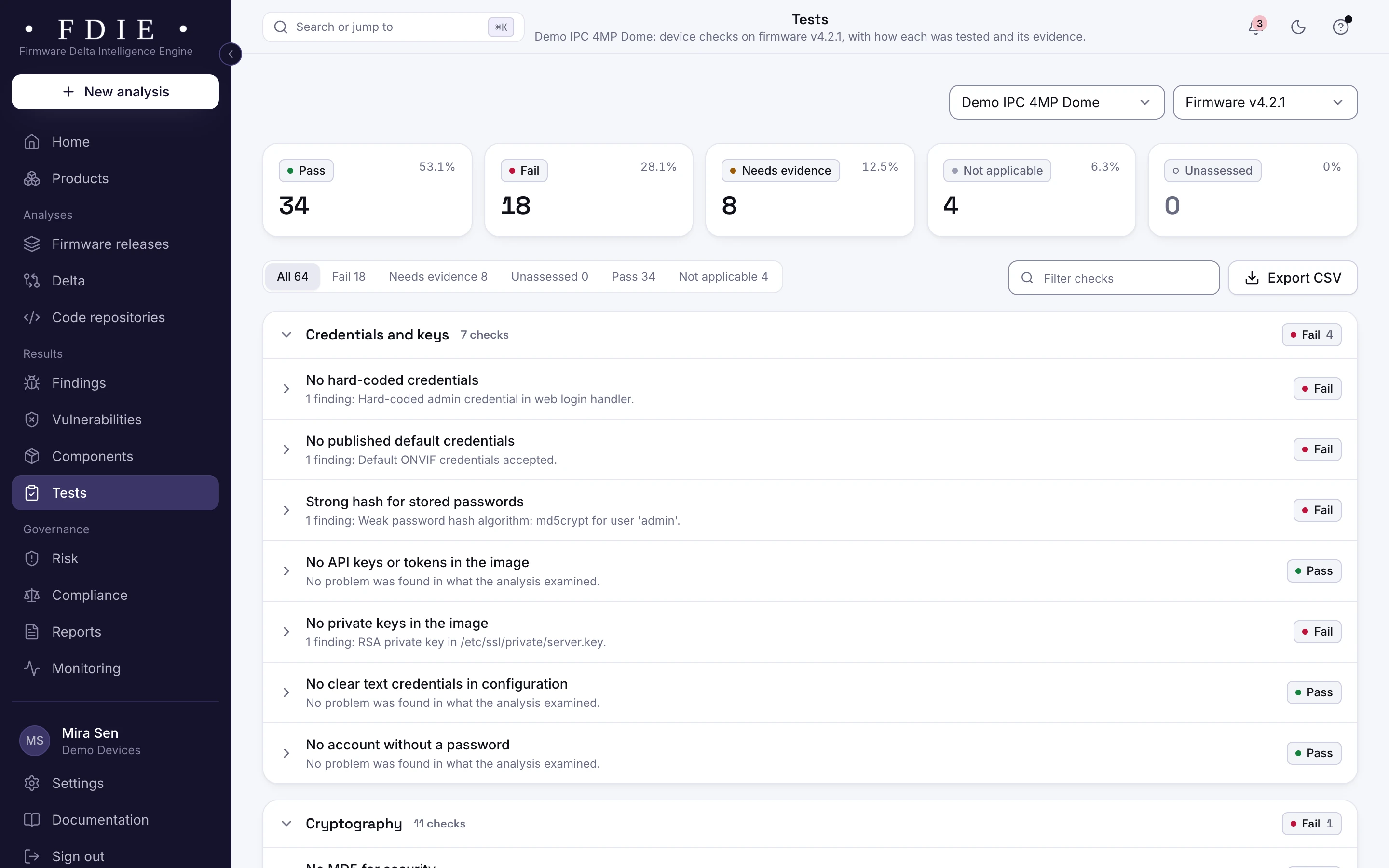
Device checks for one firmware release: all 64 checks counted as passed, failed, needs evidence, not applicable and unassessed, and the credentials and keys group with each check and what was found, for example a hard-coded admin credential, default ONVIF credentials and an MD5 crypt password hash.The same screen in the light theme.

Risky input paths in the web admin

In compiled programs, FDIE traces untrusted input such as web form fields, NVRAM values and network data to risky calls, and reports each path as a lead with its confidence for your team to confirm. Connect the source and the code engine reads shell and CGI scripts, Lua and LuCI, ucode handlers and the device's web pages.

  • Command injection and memory safety leads, with the path followed
  • CGI, Lua, LuCI and ucode handlers read as firmware code
  • Code findings beside the firmware findings of the same product
Source code analysis
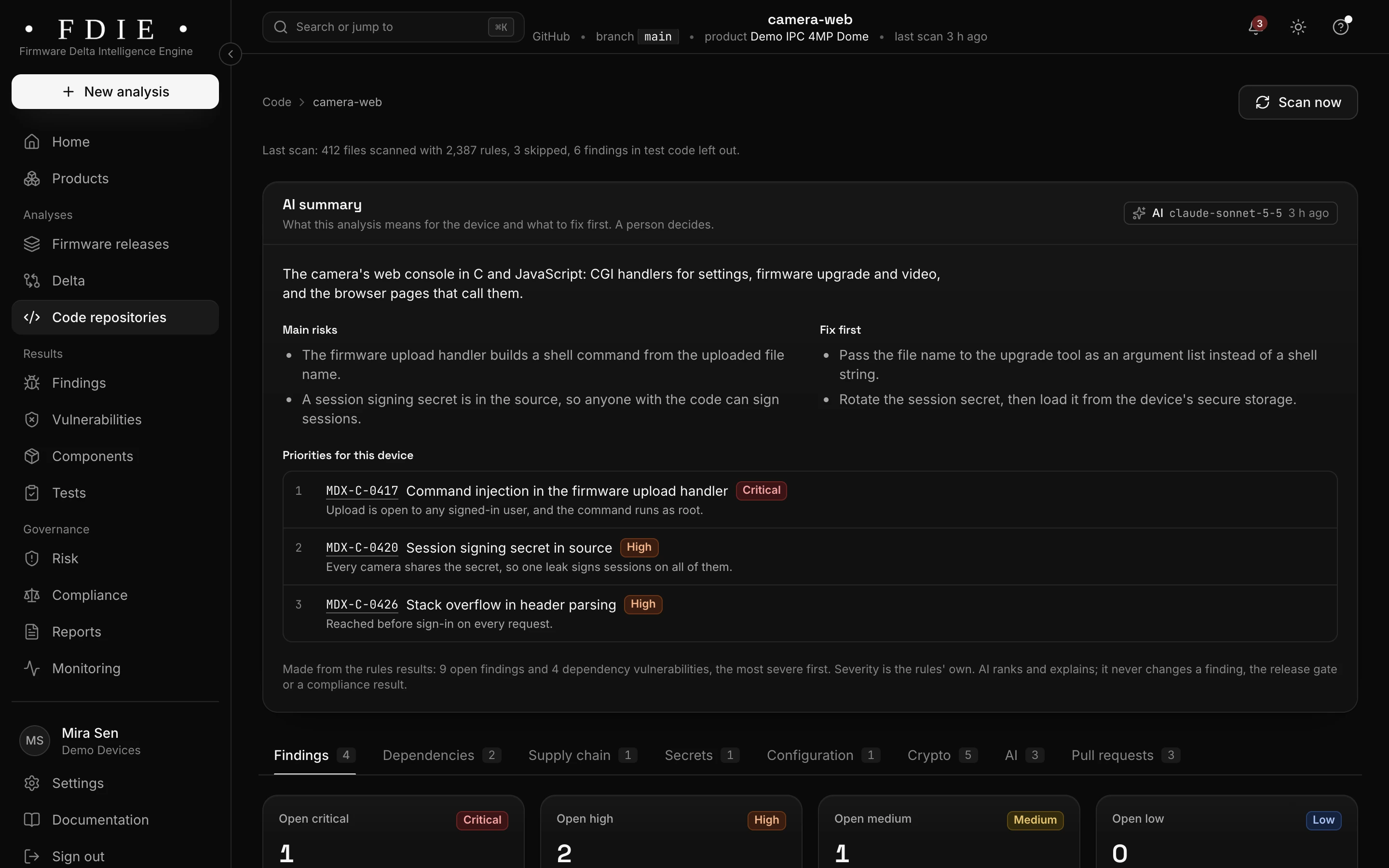
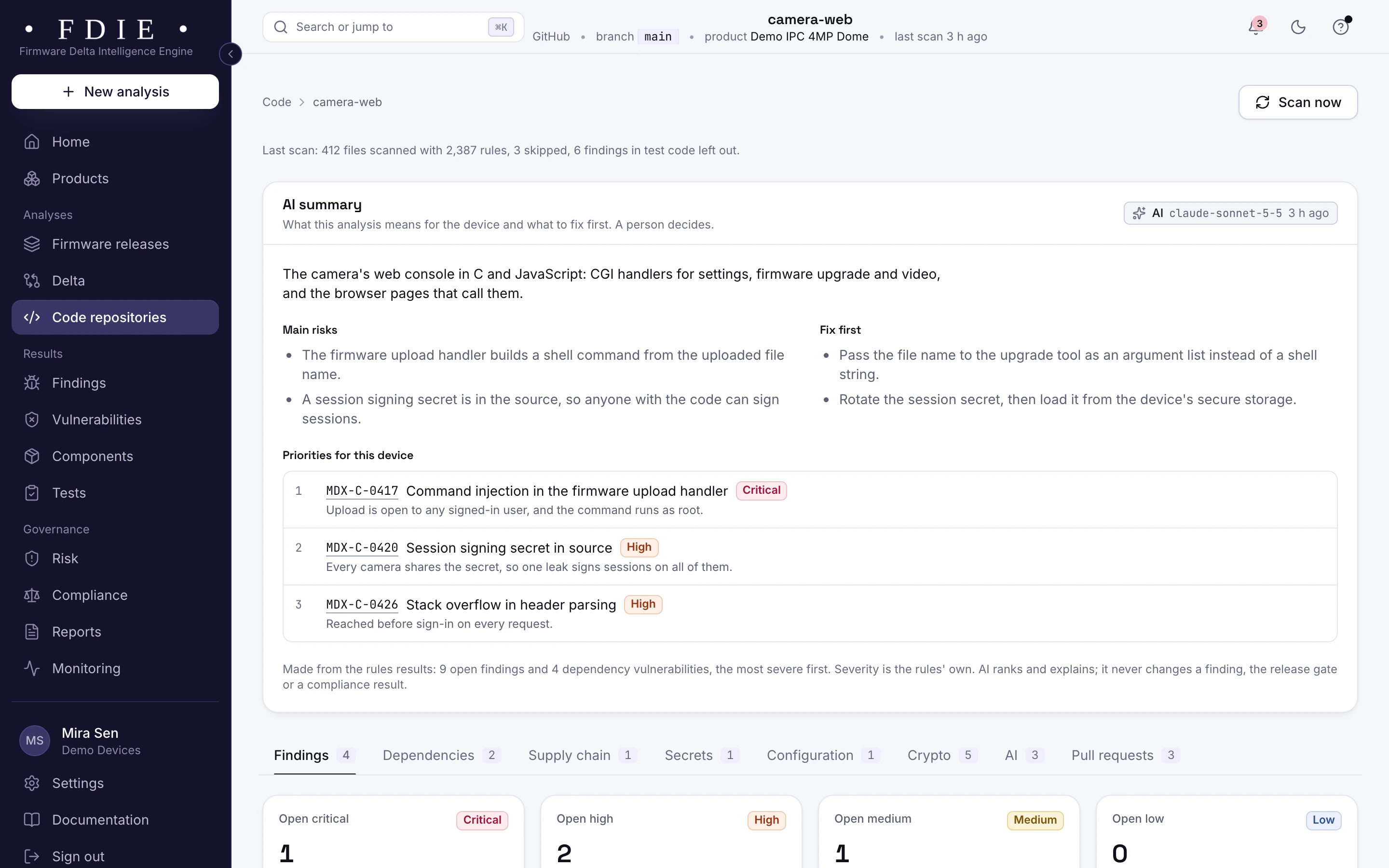
A connected GitHub repository for the camera's web interface: the AI summary of its main risks and what to fix first, three priorities (command injection in the firmware upload handler, a session signing secret in source and a stack overflow in header parsing), and tabs for findings, dependencies, supply chain, secrets, configuration, crypto, AI and pull requests.The same screen in the light theme.

Evidence for ITSAR and EN 18031

The app holds NCCS ITSAR for IP routers and for Wi-Fi CPE as two frameworks. Device checks decide running without system privileges and integrity checks at boot, and give part of the evidence for removing default accounts, brute-force protection, secure updates, unused services, HTTPS and input validation. For products sold in the EU, the same checks give evidence for EN 18031.

  • ITSAR for IP routers and Wi-Fi CPE, version 2.0.0
  • Each provision decided, helped or left to you
  • Evidence packs for the lab and for operators
Rules for India
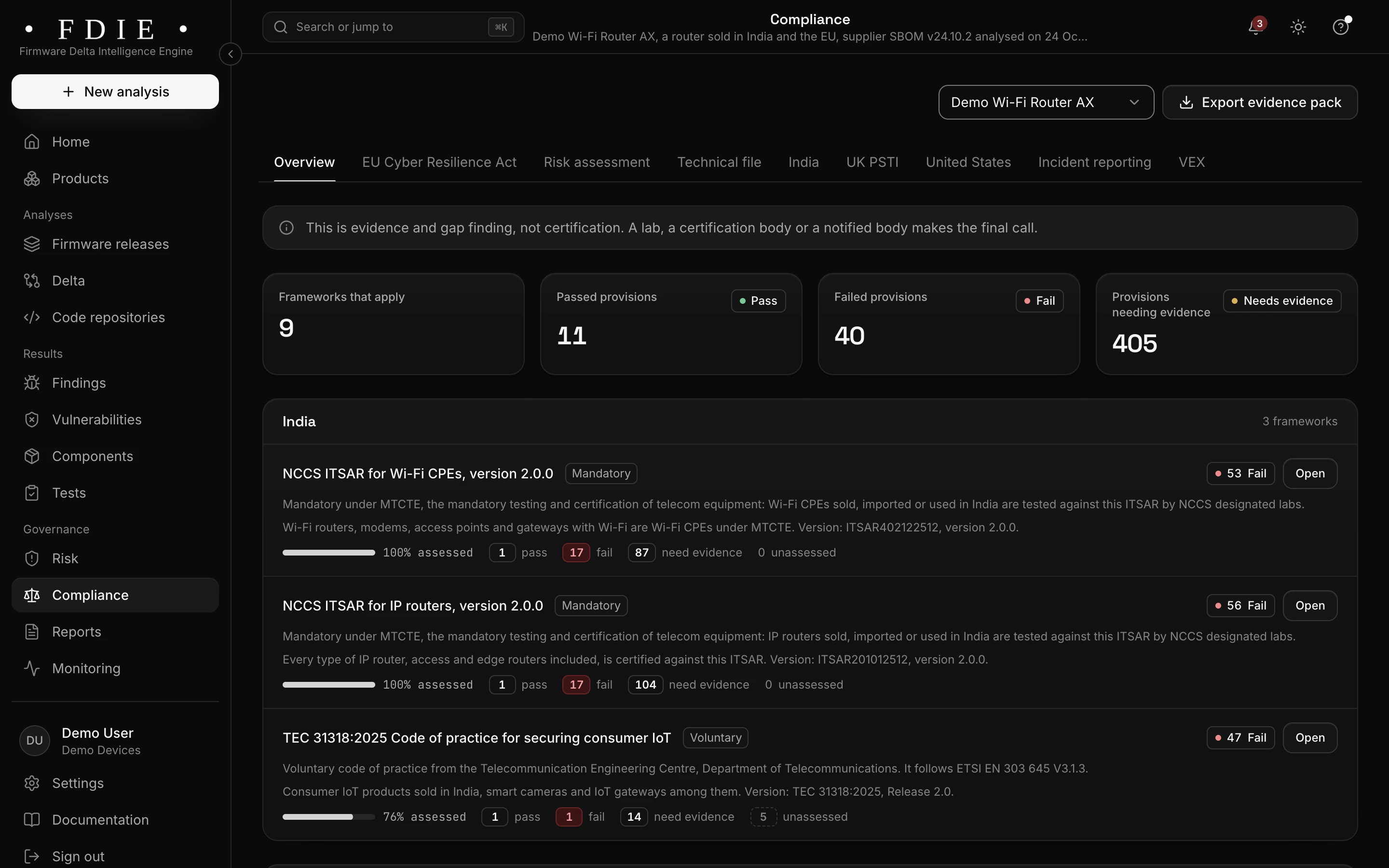
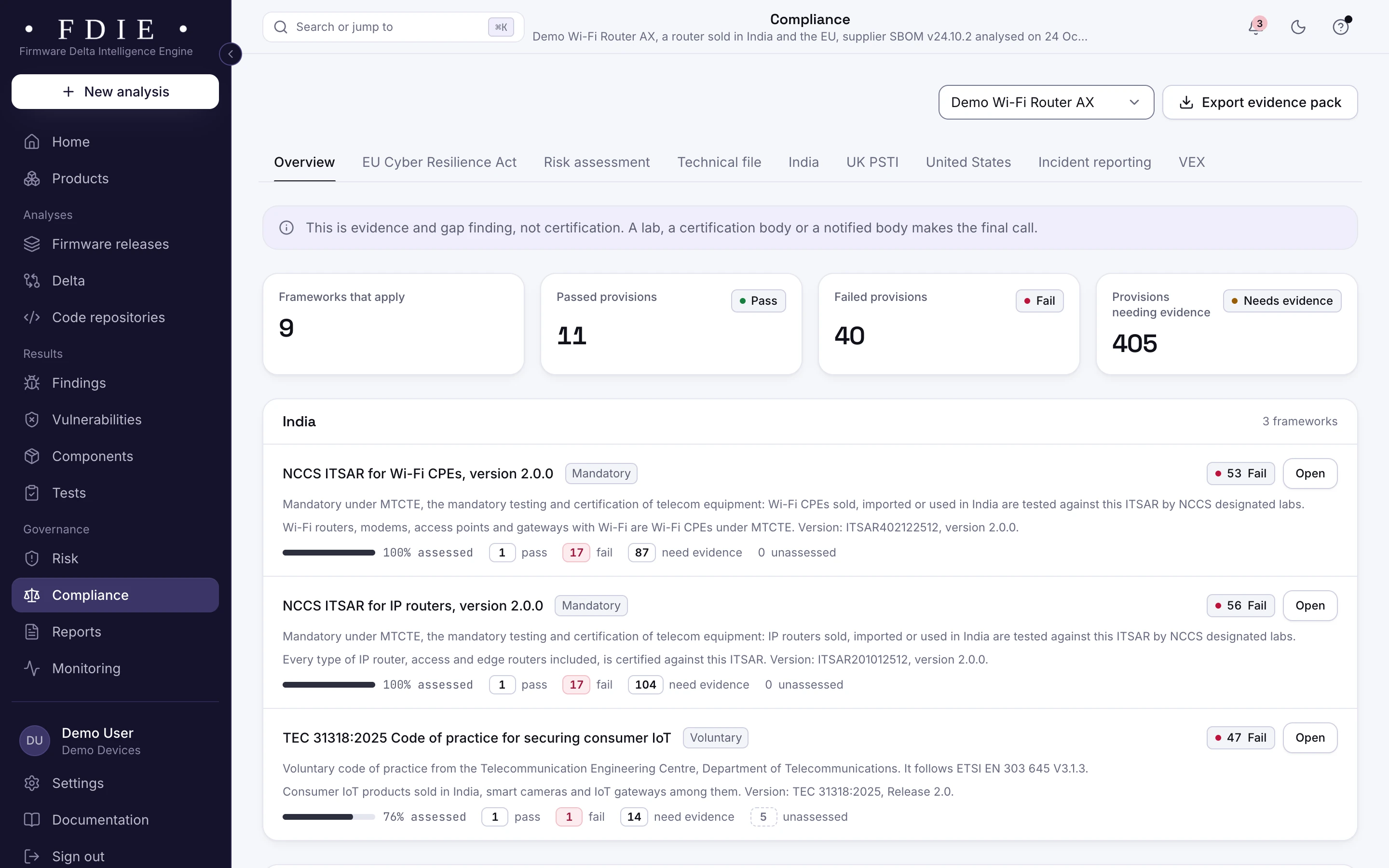
Compliance for a router sold in India and the EU: nine frameworks apply, with NCCS ITSAR for Wi-Fi CPEs and for IP routers and TEC 31318 listed under India, each with its pass, fail and need-evidence counts.The same screen in the light theme.

How it works

From firmware image to evidence in four steps

  1. 1

    Add the image and the source

    Upload the firmware or let CI send it, and connect the repository or build tree if you have it.

  2. 2

    Image and code analysed

    The image is unpacked and disassembled, and the code engine reads the CGI, Lua, ucode and configuration files.

  3. 3

    Review leads and checks

    Confirm input path leads, turn off services you do not need and fix failing checks.

  4. 4

    Evidence for labs and operators

    Export the ITSAR evidence, the SBOM and signed reports, and gate each build in CI.

Know the split

What the image shows, and what stays with the lab

FDIE analyses the firmware, not the device. Knowing the split tells you what to fix before the lab and what to prepare for it.

From the firmware image, in FDIE

  • Components, their versions and known vulnerabilities
  • Services set to start, such as telnet, UPnP and SNMP
  • Default and hard-coded accounts, keys and tokens
  • Input paths in compiled programs, as leads
  • Signed updates, boot integrity and binary hardening

On the device, with your testers or the lab

  • TR-069 sessions with your ACS and live protocol tests
  • Fuzzing and load tests on the running router
  • Hardware ports on the board
  • The ITSAR test report and certificate

Rules by market

Rules this helps with

In India, ITSAR certification is mandatory for IP routers and Wi-Fi CPE: since 1 July 2024 for models not yet certified, and since 1 October 2024 for certified models that change hardware or software. EN 18031 shows radio equipment meets the Radio Equipment Directive until the EU CRA applies in full on 11 December 2027.

Compliance by market

India

EU and UK

International

Evidence and gap finding, not certification: the lab or certification body decides.

Deliverables

What your team gets

  • ITSAR evidence

    Provisions for IP routers and Wi-Fi CPE, decided, helped or left to you.

  • SBOM for operators

    Every component in CycloneDX 1.6 or SPDX 2.3.

  • Pre-certification report

    A signed PDF of checks, findings and fixes for the release.

  • Code findings and fixes

    Web admin and CGI findings, and upgrade pull requests your team merges.

  • Release gate in CI

    Ship or hold for every build, with the reasons.

  • Alerts for shipped models

    New flaws in a supported router's components, by email, chat or webhook.

Questions

Does it read OpenWrt images?

Yes. It reads the file systems and vendor wrappers OpenWrt images use, such as SquashFS and TRX, and with the build tree connected it reads OpenWrt's configuration and LuCI code too.

Are the input path findings confirmed bugs?

No. They are leads, each with its confidence and the path the engine followed, for your team to confirm with the code or a test.

Does it test TR-069?

Not as a live test. FDIE lists the services and programs in the image, matches their components to known vulnerabilities and flags services the product does not need. A TR-069 session with your ACS needs the running router, which stays with your testers.

Does it replace ITSAR testing?

No. The test lab or certification body still decides. FDIE shows what is in your firmware and prepares the evidence, so you fix problems first and submit with fewer surprises.

Does it cover industrial gateways?

Yes, for the firmware. Gateways on ARM, MIPS, PowerPC or x86 are read the same way, and the app holds IEC 62443-4-2 for industrial components.

Find out what the lab would flag in your firmware

A 45-minute call with our team. Bring one firmware image.

Request access