For makers of IP cameras, NVRs, routers, gateways and doorbells
Firmware security for every release you ship
FDIE finds the components, exploitable vulnerabilities, hard-coded secrets and failing security checks in your firmware, shows what changed since your last release and keeps watching what you shipped. With the evidence the EU Cyber Resilience Act, EN 18031, UK PSTI, India's ER: 01 and other rules ask for.
- See what the chip vendor's SDK put in your firmware
- Answer "are we affected?" the day a new vulnerability is published
- Prove each update fixed what it promised
Built on the standards your customers and regulators use
- NVD
- OSV
- CISA KEV
- FIRST EPSS
- CycloneDX 1.6
- SPDX 2.3
- OpenVEX
- CSAF 2.0
- OWASP FSTM
Most of the code in your firmware is code you did not write
A camera or router image carries the chip vendor's SDK, dozens of open-source packages and code from contractors. Your team answers for all of it, to regulators, auditors and customers, before you ship and every day after.
The SDK ships more than you think
Old OpenSSL and BusyBox builds, telnet and debug tools left on, and default accounts arrive with the chip vendor's board support package. They rarely show in your own source or build manifests, so they surface late: in an assessment, a customer's review or an attack.
New vulnerabilities keep arriving after you ship
New vulnerabilities are published every day, and some are exploited before a fix exists. Customers and operators ask whether you are affected, and the answer has to cover every release still in the field.
Every market asks for different proof
The EU Cyber Resilience Act's reporting duties apply to products sold in the EU since 11 September 2026, and UK PSTI since 29 April 2024. In India, the CCTV rules (ER: 01) apply since 9 April 2025 and NCCS ITSAR to routers since 1 July 2024.
One analysis for every release
Bring the firmware image, and the source if you have it. FDIE reads both and turns them into the findings, evidence and decisions a release needs.
You bring
- A firmware image of up to 8 GiB, uploaded or imported from a GitHub or GitLab release
- Its source code from GitHub, GitLab, Bitbucket or Azure DevOps, if you have it
- A supplier's SBOM, when there is no image
FDIE reads
- File systems, vendor formats and microcontroller images, with our own readers
- Programs for 22 instruction sets, disassembled
- Source, dependencies and build settings, with the code engine
- Run only under emulation, in an isolated job, if you choose
You get
- Every component, as an SBOM
- Vulnerabilities, known exploited first
- 64 security checks with their evidence
- Default passwords, keys and weak crypto
- Code findings beside firmware findings
You decide and send
- Ship or hold, with the reasons
- Evidence for each requirement of 17 frameworks
- Signed reports for auditors and customers
- Alerts when a new vulnerability affects a shipped release
Before you ship, and every day after
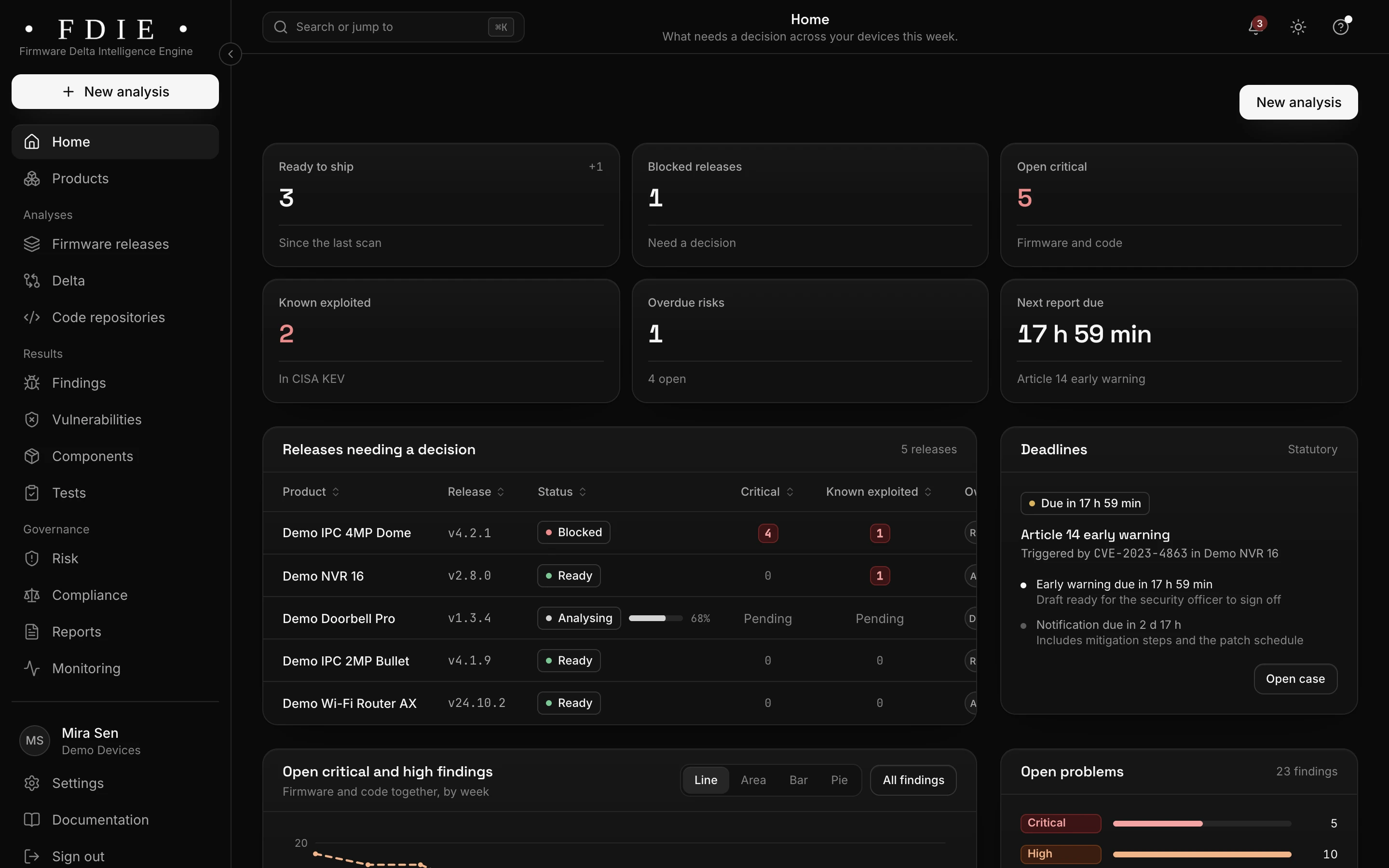
Screens from the app, with its analyses of public, deliberately vulnerable training firmware.
Release gate
Stop a risky release before it ships
Every release is checked against your release rules before it leaves your team, with the reasons it would fail. What the analysis could not check is named, never counted as a pass.
- Ship or hold, with the rule that failed
- Accepting a risk takes a second person
- What was not checked is named, never a pass
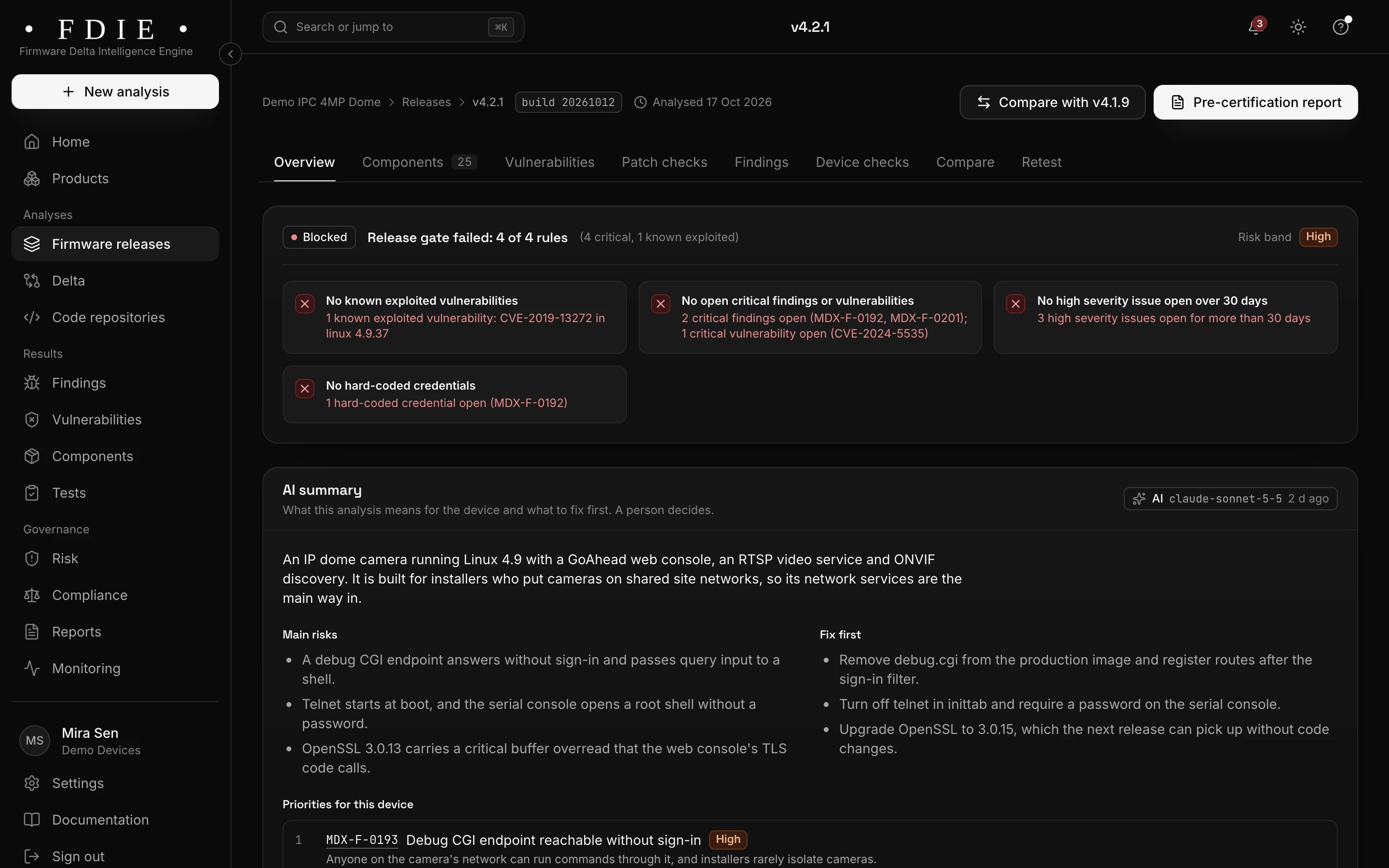
Vulnerabilities
Know the day a new vulnerability affects you
Components are matched to known vulnerabilities from NVD and OSV, the ones attackers already use first (CISA KEV), then by how likely they are to be exploited (EPSS).
- Known exploited first, from CISA KEV
- Whether your programs call the vulnerable function
- Shipped releases checked again every day
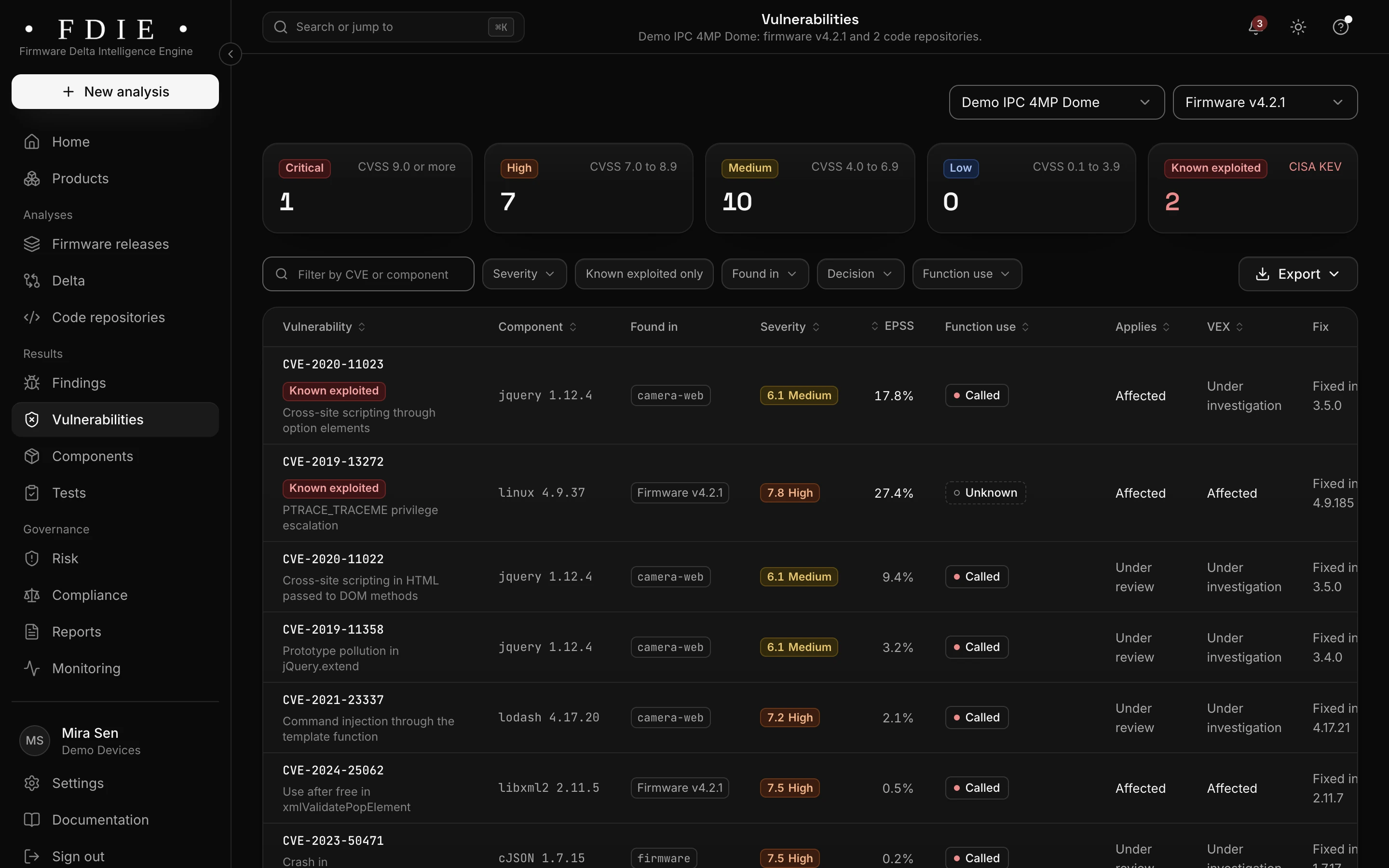
Security checks
See what an attacker or an auditor would find, before they do
64 checks in 9 groups test what attackers and assessors look at first: credentials and keys, cryptography, binary hardening, secure boot, updates and attack surface. A check passes only when every test behind it ran clean.
- Mapped to the requirements of each framework
- Pass, fail, needs evidence, not applicable or unassessed
- Exported as CSV for your auditor
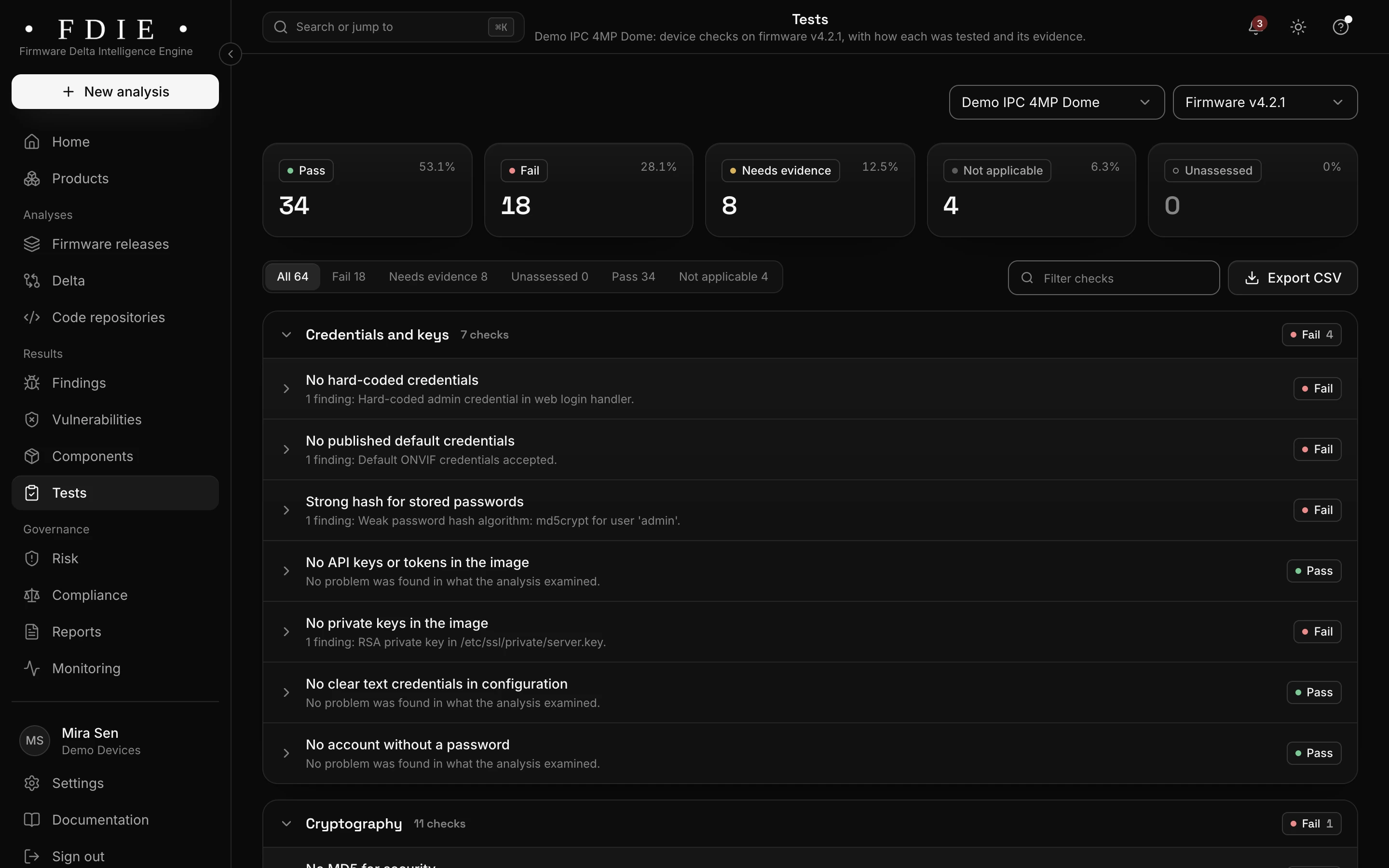
Release comparison
Prove an update fixed what it promised
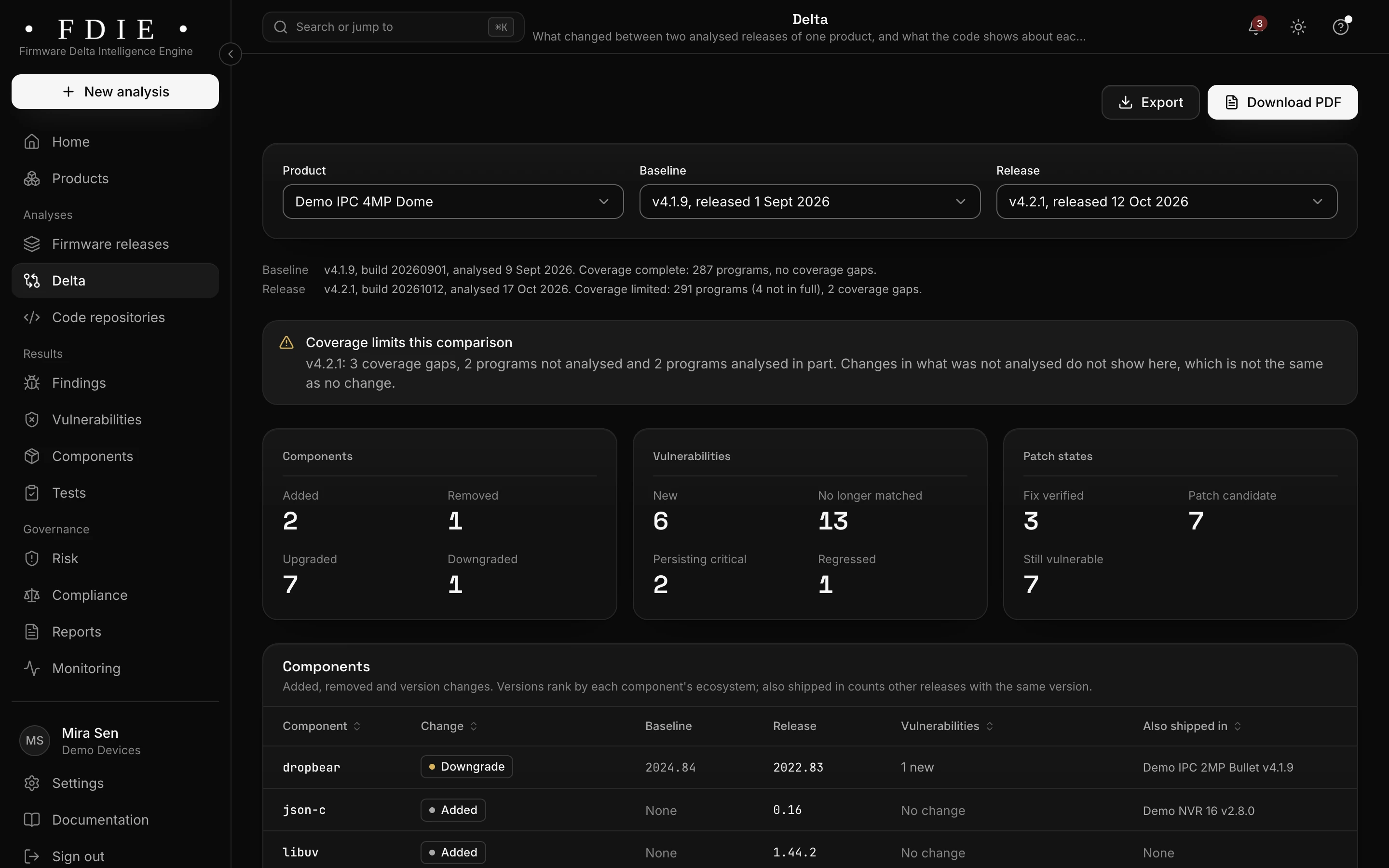
Compare two releases: what was added, removed or upgraded, and whether each vulnerability is fixed in the code itself, even when the version string did not change.
- Components added, removed, upgraded and downgraded
- Fix verified, patch candidate or still vulnerable
- A delta report to share as a PDF
Also in every analysis
Default passwords, keys and weak crypto
Hard-coded passwords, private keys, tokens and default camera accounts in the image and the source, shown masked, with MD5, DES and short RSA keys flagged.
Your source code
1,784 rules read embedded C and C++, Lua, shell and CGI scripts, device web pages and build configuration.
Fix pull requests
Exact dependency upgrades open as pull requests on a new branch in your code host, never merged for you.
SBOM and VEX
Component lists in CycloneDX 1.6 or SPDX 2.3, and your VEX statements as CycloneDX, OpenVEX or CSAF 2.0.
Signed reports
Readiness reports, evidence packs, device passports and delta reports, as PDFs signed with Ed25519.
A release gate in CI
Your pipeline uploads each build and fails on the gate, in Jenkins, GitHub Actions, GitLab CI, Azure DevOps or Bitbucket.
How it works
Upload the firmware you plan to ship
An image of up to 8 GiB, or imported from a GitHub or GitLab release. Connect its source code if you have it; you do not need it.
We read everything inside it
Our own readers unpack the image and disassemble its programs, and the code engine scans the source. With runtime evidence on, programs from the image also run under emulation in a separate isolated job.
Fix what would fail
Findings with owners and how to fix them, security checks with their evidence, and each requirement with what is still missing.
Ship, report and keep watching
A ship or hold decision with its reasons, signed reports for auditors and customers, and shipped releases matched against new vulnerabilities every day.
Evidence for regulators, auditors and customers
Each requirement of the 17 frameworks for the EU, the UK, the US, India and international standards, with its status and the evidence behind it, for each analysed release.
European Union
- EU Cyber Resilience Act, Annex I
- EN 18031-1
- EN 18031-2
- EN 18031-3
- prEN 40000 drafts
United Kingdom
- UK PSTI
United States
- California and Oregon IoT laws
- NIST IR 8425
- NIST IR 8259A
- NDAA 889 component evidence
India
- TEC 31318:2025
- MeitY ER-01
- NCCS ITSAR for IP routers
- NCCS ITSAR for Wi-Fi CPE
International
- ETSI EN 303 645
- IEC 62443-4-2
- OWASP FSTM
Built for product security, engineering and compliance teams
From the engineer who fixes the build to the person who answers a customer's security review.
IP cameras and NVRs
Default camera and ONVIF accounts, open streams, debug access and evidence for ER: 01.
Cameras and NVRsRouters, gateways and Wi-Fi CPE
Services left on, update signing, web interface injection and evidence for NCCS ITSAR.
Routers and gatewaysSmart home devices and doorbells
Default passwords, the disclosure policy and update period for UK PSTI and ETSI EN 303 645.
Smart home and doorbellsMicrocontroller devices
ESP32, Cortex-M and other microcontroller firmware in Intel HEX, S-record, UF2 and DfuSe files.
Processors we read
Firmware engineering
What the SDK put in the image, where each problem sits and how to fix it in the code.
Product security
Whether a new vulnerability affects what you shipped, known exploited first.
Compliance and certification
Evidence for each requirement, gathered before an auditor or a regulator asks.
Sales and bids
Answers for customers' security questionnaires and tenders, as an SBOM, VEX statements and signed reports.
Full results without AI. Sharper with yours.
FDIE's own rules and engines find the components, vulnerabilities and failing checks with no AI at all. Bring your own AI key (BYOK), and your AI explains findings, proposes triage, reviews functions and suggests code fixes on top.
Results without AI
Every finding comes from FDIE’s rules and engines, with or without a key. AI never decides a result.
Your AI sharpens them
Connect your own provider and model. It explains what a finding means, judges whether a vulnerability applies to your product and sorts real secrets from test values.
People decide
AI explains and proposes. It never changes evidence, and a person accepts or rejects every proposal.
We never train on your data
MAGDOX never uses your data to train AI. If you connect your own AI provider, your agreement with it decides how it may use what it receives.
Why MAGDOX
Hosted in your region
Your firmware, findings, reports and backups stay in the region you choose: India, the European Union or the United States. Each organisation is kept apart in the database, and everyone signs in with two steps.
Every release, every day
Each release goes through the same analysis, uploaded by hand or sent by your CI pipeline, and the newest release of each supported product is matched against new vulnerabilities every day.
Known exploited first
Vulnerabilities attackers already use (CISA KEV) come first, then the likeliest to be exploited (EPSS). Function use shows whether your programs call the vulnerable function.
Patch verification, down to the function
Compare two releases down to their functions, and see whether each fix is in the code itself, even when the version string did not change.
Check our work
The formats, processors, checks, rules and limits behind each result are published. What we cannot read is listed as a coverage gap, never counted as a pass.
Run only where it is safe
Both engines read the image and the source without running anything in them, and unpacking refuses archive bombs. With runtime evidence on, programs from the image run only under emulation in a separate isolated job, with the firmware's own network refused.
Evidence, not a badge
Each requirement shows what passed, what failed and what still needs your evidence, with who added it and when.
Built for firmware first
Our own readers for flash file systems, vendor headers and microcontroller images, and code rules written for embedded C, Lua, shell and device web pages.
An Indian company
MAGDOX Private Limited, founded in 2025 and led by Manish Sharma, Chief Executive Officer.
Questions
Do I need the source code?
No. A firmware image on its own gives you components, vulnerabilities, security checks, secrets, delta and patch checks. Connecting the source adds code findings to the same product.
Is anything in my image run?
Only with runtime evidence. Both engines read the image or the source without running anything in it; with runtime evidence on (on Business by default), programs from the image also run under emulation in a separate isolated job, with the firmware's own network refused.
Which devices does it suit?
IP cameras, NVRs, routers, gateways, Wi-Fi CPE, doorbells and other connected devices on embedded Linux, and microcontroller devices such as ESP32 and Cortex-M. The technical details list every format and processor.
What do auditors and customers receive?
Signed PDF reports: readiness reports, evidence packs, device passports, retest and delta reports. With them, the SBOM in CycloneDX or SPDX and your VEX statements in CycloneDX, OpenVEX or CSAF 2.0.
How do we begin?
Book a 30 or 45 minute demo to see the app with your questions, or request access: our team sets up a paid pilot on your own firmware.
See what is inside your next release
Book a 30 or 45 minute demo with the team that builds FDIE, or request access for your organisation.