For leaders
Choosing a firmware security platform: questions to ask first
By Manish SharmaPublished 6 min read
Firmware security tools are easy to compare on feature names and hard to compare on evidence. Choose a firmware security platform by what it can prove on your own images. Look at the formats and processors it reads, how it reports what it could not read, which SBOM and VEX formats it exports and which markets' rules it maps to. On the vendors' own pages, ONEKEY publishes a longer list of firmware formats, exports more CycloneDX versions and holds ISO/IEC 27001. FDIE by Magdox covers India's ER-01, NCCS ITSAR and TEC 31318, exports VEX in three formats and publishes measured rates. Both import supplier SBOMs.
In short
- Judge a firmware security platform by what it can prove on your own images, not by feature names.
- Ask where your firmware goes, what the tool does with parts it cannot read, which SBOM and VEX formats it exports and which of your markets' rules it covers.
- On their own pages, ONEKEY lists more firmware formats, covers UK and car rules and holds ISO/IEC 27001. FDIE by Magdox covers India's rules, exports VEX in three formats and publishes measured rates.
Buy on evidence, not feature names
Buy on evidence you can check, not on feature names. Every platform in this market unpacks firmware, lists components and matches them to known vulnerabilities. So the differences sit in the details:
- which formats and processors were measured on real images
- what happens to the parts a tool could not read
- which SBOM and VEX formats come out: the list of components, and the statement of which flaws affect you
- which markets' rules it maps to
- where your firmware goes
Below is the checklist we would use if we were buying. After it comes a side by side of our product and ONEKEY, a well-known platform in this market. Every ONEKEY statement comes from ONEKEY's own website or documentation as we read it on 20 October 2026, linked in the sources. Products change, so check the live pages before you decide.
Twelve questions for any vendor
- Where is my firmware processed and stored, and under which country's law?
- Which file systems and containers have you measured on real vendor images, not only on test samples?
- Which instruction sets do you disassemble, and how did you measure it?
- What happens to a part of the image you cannot read or decrypt? Is it named as a gap, or does the check pass?
- How accurate is your SBOM, measured against what? A package manifest is a good yardstick.
- Can I import my suppliers' SBOMs?
- Which SBOM and VEX formats and versions do you export?
- Which of my markets' frameworks do you map evidence to, and which requirements still need my documents?
- Do you compare each release with the previous one, and can I export that comparison?
- Do you run the firmware, and if you quote a success rate, on how many images and by what definition?
- What does AI see of my firmware, whose model is it, and can I turn it off?
- Which security certifications does your own company hold?
Question 4 matters more than it looks. A tool that silently skips what it cannot read produces a clean report on the riskiest image you own.
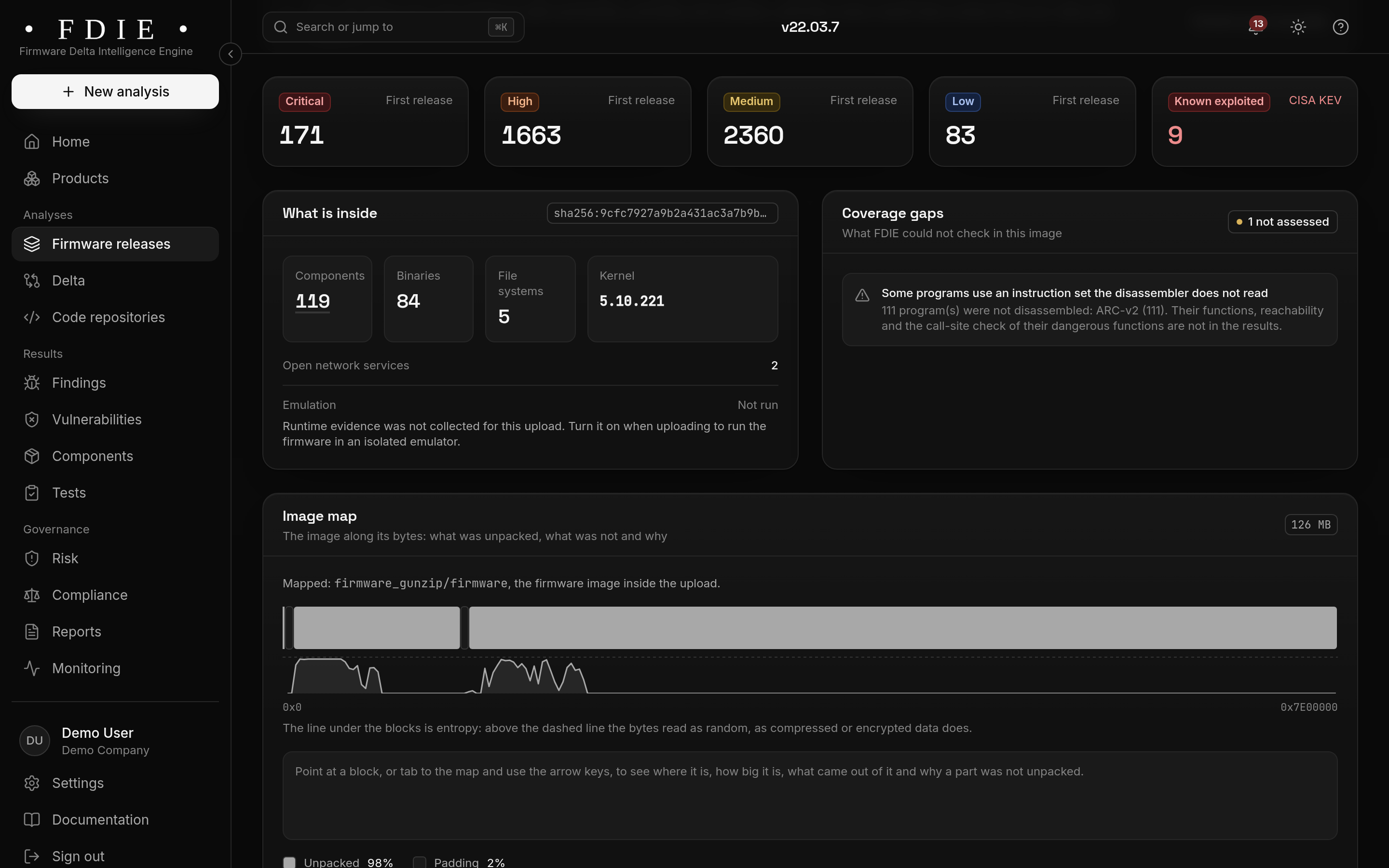
FDIE by Magdox and ONEKEY, side by side
ONEKEY's column uses only what its pages state. "Not stated" means we did not find it on the pages we read, not that the product lacks it.
| What you might compare | ONEKEY (its pages, 20 October 2026) | FDIE by Magdox |
|---|---|---|
| Delivery | "a cloud platform, so there is nothing to install" | Hosted service only |
| Where data is hosted | Not stated on the pages we read | India, unless your contract sets another location |
| Firmware formats | A long published list of archives, file systems, executables and bootloader formats, including UEFI, QNX, VxWorks MEMFS, LittleFS and many vendor containers | A published list; UEFI volumes and capsules; Intel HEX, S-record, UF2 and DfuSe with entry point and interrupt handlers; formats tested only on sample files are marked as such |
| Instruction sets | Not listed on its formats page | 22 disassembled, each measured against compiler ground truth; ARC read but not disassembled |
| Supplier SBOM import | Yes, CycloneDX JSON 1.2 to 1.7 and XML 1.1 to 1.7, attached at upload | Yes, a release can be analysed from a supplier's SBOM instead of the firmware: CycloneDX 1.4 to 1.6 (JSON or XML), SPDX 2.2 or 2.3 (JSON or tag-value) and SPDX 3.0 (JSON), up to 20 MiB |
| SBOM export | CycloneDX JSON 1.2 to 1.7 and XML 1.1 to 1.7; SPDX 2.3 JSON and XML | CycloneDX 1.6 and SPDX 2.3 |
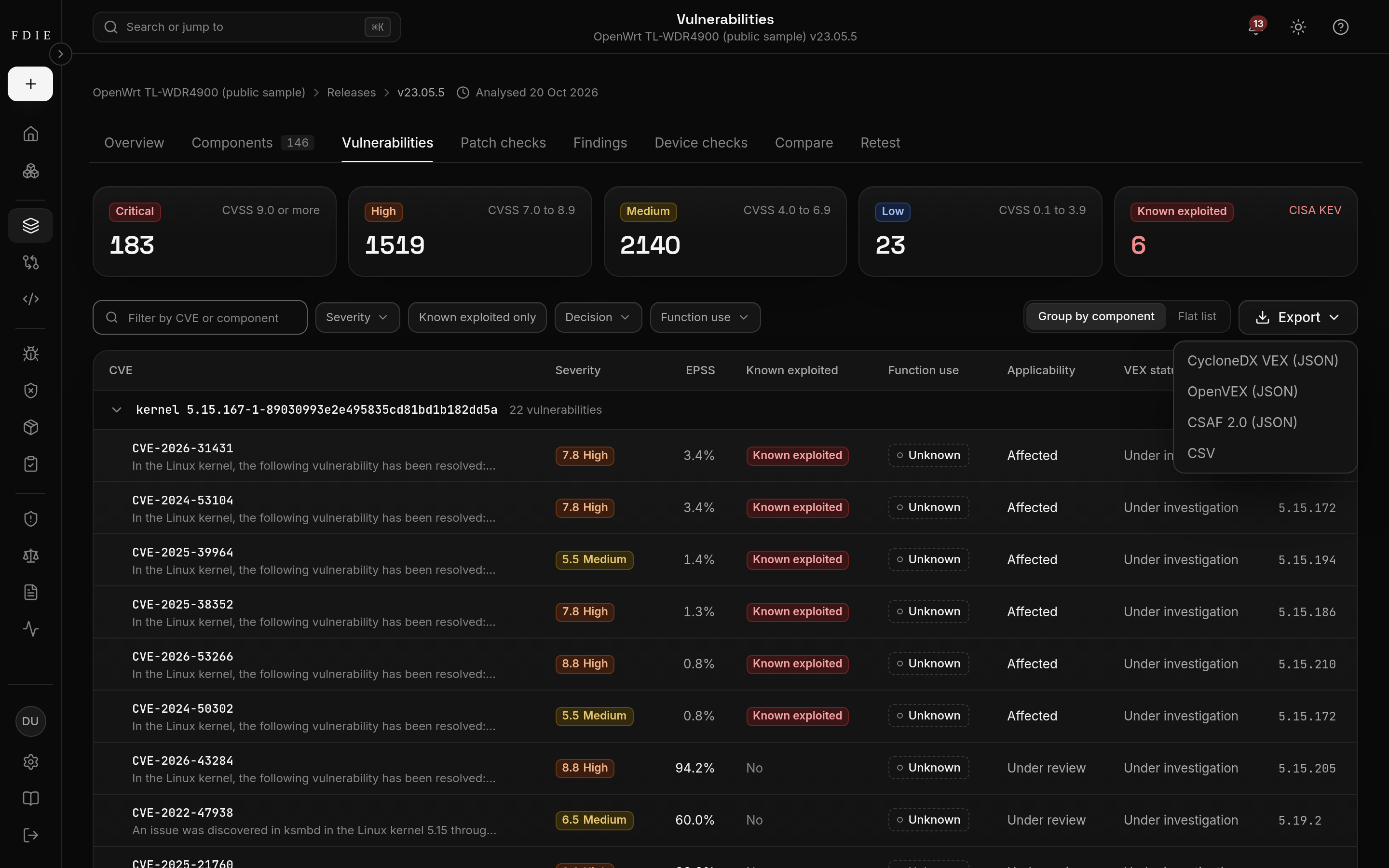
| VEX export | CycloneDX ("CycloneDX only") | CycloneDX, OpenVEX and CSAF 2.0 |
| Indian frameworks | None among the 15 guidelines its Compliance Wizard lists | MeitY ER-01, NCCS ITSAR for IP routers and for Wi-Fi CPE, TEC 31318 |
| Other frameworks | 15 guidelines, including the CRA, EN 18031-1, ETSI EN 303 645, IEC 62443-4-2, NIST IR 8259A, UK PSTI, UN Regulation No. 155 and Singapore's labelling scheme | 14 in all, including the CRA, EN 18031-1, -2 and -3, ETSI EN 303 645, IEC 62443-4-2, NIST IR 8259A and 8425 and OWASP FSTM; not UK PSTI or UN R155 |
| Running the firmware | Not described on the pages we read; its zero-day page describes static analysis | Measured in our lab (51 of 87 real images ran); being added to the app |
| Source code | Imports SBOMs from source code scanners; zero-day detection covers binaries and PHP, Python, Bash and Lua scripts | Scans connected repositories on GitHub, GitLab, Bitbucket and Azure DevOps with its own code engine |
| AI | An AI agent, with a "Bring Your Own Model" option | Only with the customer's own AI provider key; we supply none |
| Vendor's own certification | ISO/IEC 27001 certified | No ISO 27001 certificate or SOC 2 report today |
| Pricing | Quote on request | Quoted; no published prices |
Both import a supplier's SBOM. ONEKEY accepts more CycloneDX versions, and FDIE also reads SPDX.
Where ONEKEY is stronger
On its own pages, ONEKEY publishes a longer list of supported firmware formats than we do, and exports more CycloneDX versions. It maps to UK PSTI, the UK's product security law, and to UN R155, the UN rule on vehicle cyber security. It also holds an ISO/IEC 27001 certificate for its own security management.
ONEKEY offers consulting, penetration testing and readiness assessments for the EU's CRA and Radio Equipment Directive (RED) as well. If your products ship mainly to the UK or to carmakers, or you want one company to run the tests too, those count.
Where FDIE by Magdox is ahead, and the evidence
We are ahead where an Indian maker needs it most. FDIE maps evidence to MeitY ER-01, the CCTV security test, to both NCCS ITSAR documents for routers and Wi-Fi equipment, and to TEC 31318. It exports VEX in CycloneDX, OpenVEX and CSAF 2.0, which matters when a customer's tools read only one of them.
We also publish our measurements with their test sets. On programs stripped of their symbol names and built for eight instruction set variants, we found 98.5% of function starts at 99.1% precision. That is level with or ahead of Ghidra 12.1.4 and Rizin 0.9.1, two well-known analysis tools, on every metric except string references on RISC-V.
In our lab, 51 of 87 real firmware images (58.6%) ran in an emulator, which imitates the device's hardware. A network service answered after a full boot in 13 of 87 (14.9%). These are our numbers on our sets, and we have no measurement of ONEKEY's product and claim none.
Open source, if you want to run it yourself
EMBA and FACT (Fraunhofer FKIE's Firmware Analysis and Comparison Tool) are free under the GPL-3.0 licence and run on your own machines. STQC, the testing body under India's IT ministry, names FACT in its CCTV test procedure. It is given as an example of an automated tool a lab may run on the firmware to check the maker's SBOM. If your team has the time to operate them, they are worth a trial alongside any commercial platform.
How to decide
Shortlist two vendors, and give each the same three images of your own: one easy, one old, one encrypted or unusual. Compare the outputs against the twelve questions. The vendor whose report admits what it could not read is usually the one you can defend to a lab.
Questions
What should I ask a firmware security vendor before buying?
Where your firmware is processed and stored, and which formats and processors it has measured on real images. Ask how unreadable parts are reported and which SBOM and VEX formats it exports. Also ask which of your markets' frameworks it maps to, and what it does with AI.
Can FDIE by Magdox import a supplier's SBOM?
Yes. A release can be analysed from a supplier's SBOM instead of the firmware, up to 20 MiB. FDIE reads CycloneDX 1.4 to 1.6 (JSON or XML), SPDX 2.2 or 2.3 (JSON or tag-value) and SPDX 3.0 (JSON).
Does ONEKEY cover Indian regulations such as ER-01 or NCCS ITSAR?
Its compliance wizard documentation listed 15 guidelines when we read it on 20 October 2026, none of them Indian. Ask ONEKEY directly for anything added since.
Where does FDIE by Magdox host data?
In India, unless your contract sets another location. FDIE is a hosted service only.
Are there open source alternatives?
Yes. EMBA and FACT, both GPL-3.0, can be run on your own machines. STQC's CCTV test procedure names FACT as an example of a tool a lab may use to check a maker's SBOM.
Sources
- ONEKEY, platform overview (read 20 October 2026) onekey.com
- ONEKEY documentation, supported formats (read 20 October 2026) docs.onekey.com
- ONEKEY documentation, SBOM management (read 20 October 2026) docs.onekey.com
- ONEKEY documentation, Compliance Wizard (read 20 October 2026) docs.onekey.com
- ONEKEY documentation, system requirements (read 20 October 2026) docs.onekey.com
- ONEKEY, zero-day detection (read 20 October 2026) onekey.com
- ONEKEY, about us (read 20 October 2026) onekey.com
- EMBA, the firmware security analyzer (GitHub) github.com
- FACT, Firmware Analysis and Comparison Tool (GitHub) github.com
- STQC, IoTSCS P01 Procedure for CCTV Testing, Evaluation and Certification (PDF) stqc.gov.in
Product and project names are trademarks of their owners, used only to identify the public firmware, software and standards discussed. MAGDOX is not affiliated with or endorsed by them.