For leaders
Which device security rules apply where you sell, and when
By Manish SharmaPublished 7 min read
Device makers who sell in several markets face many rules that ask for overlapping evidence. Four families of these frameworks are law for some products. In India they are ER-01 for CCTV cameras and NCCS ITSAR for routers. In the EU they are the Cyber Resilience Act, and EN 18031 under the Radio Equipment Directive. The rest are voluntary baselines that buyers and labels use. Across the 720 provisions FDIE tracks in 13 of them, a firmware analysis decides 38 on its own and helps with 180. The other 502 need product data or documents, tests and procedures from people.
In short
- India and the EU now treat device security as a legal gate for some products: cameras and routers in India, connected and radio products in the EU.
- The US and international frameworks are voluntary, but buyers, labels and tenders use them as the bar.
- A firmware analysis decides or helps with 218 of the 720 provisions we track; the rest is people and process, so staff for it now.
The 14 frameworks at a glance
Which frameworks apply depends on what you sell and where; these are the 14 that FDIE by Magdox maps evidence to.
| Market | Framework | Status | Applies to | Key dates |
|---|---|---|---|---|
| India | MeitY ER-01 | Mandatory | CCTV and IP cameras, not analog | No BIS registration without it since 9 April 2025 |
| India | NCCS ITSAR, IP routers | Mandatory | IP routers | New models from 1 July 2024 |
| India | NCCS ITSAR, Wi-Fi CPE | Mandatory | Wi-Fi routers, modems, access points | New models from 1 July 2024 |
| India | TEC 31318:2025 | Voluntary | Consumer IoT | Release 2.0, November 2025 |
| EU | Cyber Resilience Act, Annex I | Mandatory | Products with digital elements | Reporting from 11 September 2026; the rest from 11 December 2027 |
| EU | EN 18031-1, -2 and -3 | Harmonised standards | Radio equipment | Required from 1 August 2025 to 10 December 2027 |
| EU | prEN 40000 drafts | Draft | Every product with digital elements | Not yet published |
| US | NIST IR 8425 | Voluntary | Consumer IoT products | September 2022 |
| US | NIST IR 8259A | Voluntary | IoT devices | May 2020 |
| International | ETSI EN 303 645 | Voluntary | Consumer IoT | V3.1.3, September 2024 |
| International | IEC 62443-4-2 | Voluntary | Industrial components, such as gateways | Edition 1.0, 2019 |
| International | OWASP FSTM | Testing method | Any firmware | None |
We do not offer the UK PSTI regime, UN R155 or ISO/SAE 21434, so plan for those separately if those markets matter to you.
India: two gates and one code
In India, cameras and routers need a security test before sale, while other consumer devices have a voluntary code.
ER-01 covers CCTV and IP cameras registered with the Bureau of Indian Standards (BIS). It asks for signed boot images and updates, no hard-coded passwords, closed debug ports and keys unique to each device, and a lab tests the camera itself.
NCCS ITSAR covers IP routers and Wi-Fi CPE such as home routers, fibre modems and access points. Its documents are long, with 179 clauses for routers and 133 for Wi-Fi CPE. A lab named by NCCS, the national telecom security centre, tests most of them on the device. Our ITSAR and TEC 31318 post shows which ones firmware can answer.
TEC 31318 is a voluntary code for consumer IoT, revised in November 2025 to follow ETSI EN 303 645. It is free to adopt, and the work carries over to buyers abroad.
European Union: one regulation, one directive winding down
Every connected product sold in the EU falls under the Cyber Resilience Act, and radio products also meet the Radio Equipment Directive until December 2027.
The CRA applies to hardware and software with a data connection. From 11 September 2026, makers must report actively exploited vulnerabilities, even for products already sold. From 11 December 2027, every product must also meet the essential requirements of Annex I. Routers, modems and smart home security cameras are important products of class I, which limits checking them yourself (self-assessment).
EN 18031 is the harmonised standard for those rules, meaning the EU standard that shows a product meets them. It comes in three parts: internet-connected radio, personal data and payments. In April 2026 the EU published the act that ends those rules on 11 December 2027, when the CRA takes over.
The prEN 40000 drafts will become the CRA's own standards, but none is published or cited yet. So meeting them does not yet count as legal proof of meeting the CRA, which the law calls a presumption of conformity. We map them so you can see the gap early.
United States: voluntary baselines
Nothing here is law for device makers, yet the baselines of NIST, the US standards institute, shape labels and buyer questionnaires.
NIST IR 8259A lists six things a device should be able to do, from secure updates to reporting its security state. NIST IR 8425 widens that to the whole product, with its app and cloud, and adds documentation and support duties.
The voluntary Cyber Trust Mark of the FCC, the US communications regulator, builds on 8425. But its lead administrator withdrew in December 2025, and the FCC reopened applications in January 2026. Check its status before planning around the label.
International: what global buyers name
These three are not tied to one market. ETSI EN 303 645 is the consumer IoT baseline behind TEC 31318. IEC 62443-4-2 sets requirements for industrial components at security levels 1 to 4, and industrial gateway buyers often ask for it.
OWASP FSTM is not a rule at all but a nine-stage way to test firmware.
What a firmware analysis can prove
It can prove what is inside the image and how it is built, but not how your company works. The counts below come from our catalogue of 13 frameworks, leaving out FSTM because it is a method.
| Framework | Provisions | Decided by device checks | Checks help | From product data | Your evidence |
|---|---|---|---|---|---|
| MeitY ER-01 | 30 | 4 | 8 | 1 | 17 |
| NCCS ITSAR (both) | 312 | 5 | 73 | 0 | 234 |
| TEC 31318 | 21 | 6 | 4 | 0 | 11 |
| CRA Annex I | 22 | 8 | 4 | 4 | 6 |
| EN 18031 (all three parts) | 51 | 1 | 37 | 0 | 13 |
| prEN 40000 drafts | 104 | 0 | 20 | 5 | 79 |
| NIST IR 8425 | 33 | 0 | 8 | 2 | 23 |
| NIST IR 8259A | 22 | 0 | 7 | 0 | 15 |
| ETSI EN 303 645 | 78 | 14 | 11 | 1 | 52 |
| IEC 62443-4-2 | 47 | 0 | 8 | 0 | 39 |
| Total | 720 | 38 | 180 | 13 | 489 |
It is strong on what an image shows: default passwords, weak cryptography, open services, unsigned updates and known vulnerabilities. It cannot see factory key loading, debug pads, your manual, or how fast you fix bugs. That part is policies, records and lab tests.
Keeping one set of evidence for every market
Each product carries its device type and markets, and the app shows only the frameworks that apply to it.
- The overview groups frameworks by market, with gaps in mandatory frameworks first.
- Frameworks that do not apply are listed with the reason; ER-01 does not apply to a router, for example.
- Each provision says how it is decided: automatic, partly automatic or needs evidence.
- Your team attaches a document, test report, procedure, link or undertaking where a provision asks for one.
- Nothing passes without a device check, product data, evidence or a sign-off.
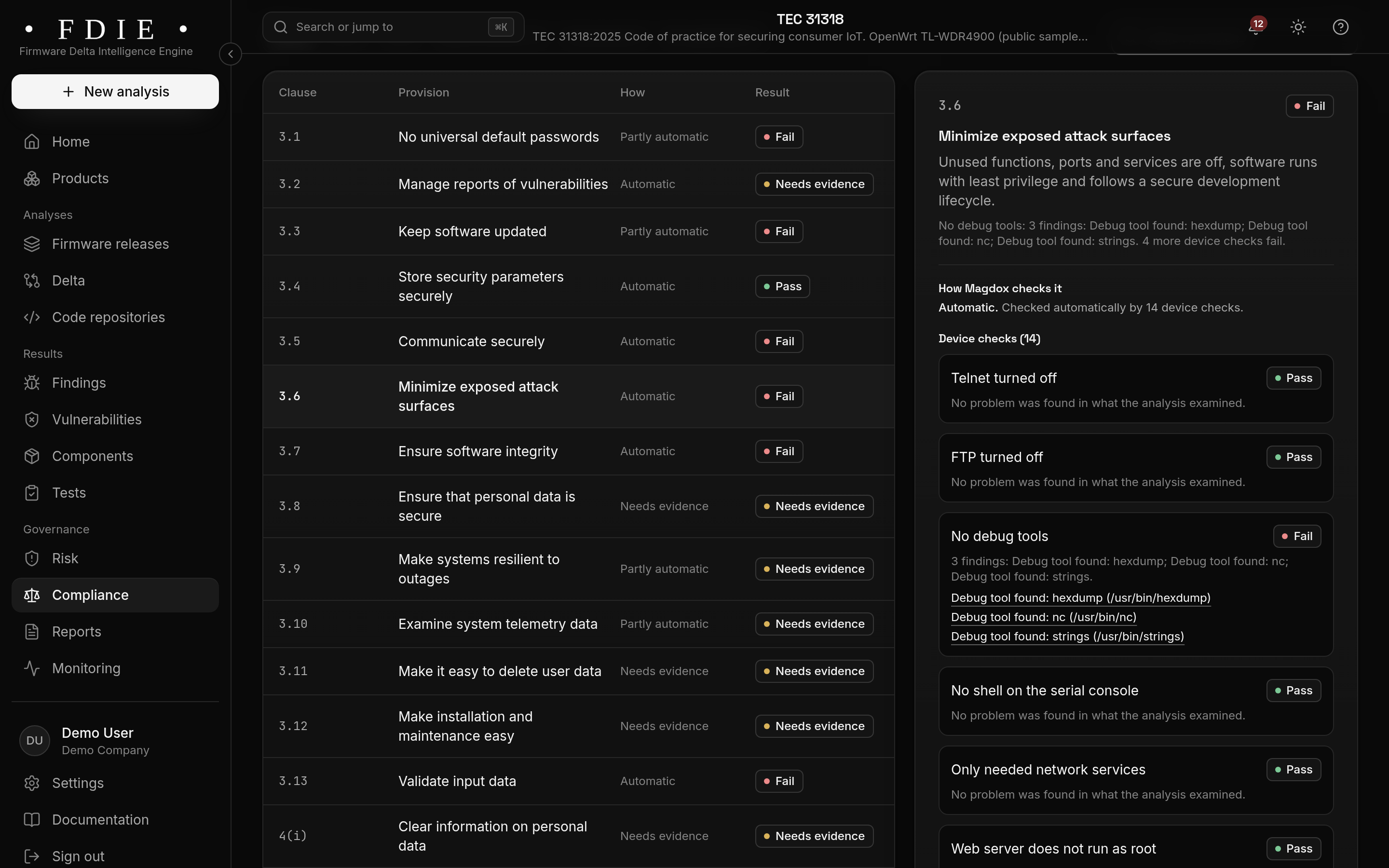
This is evidence and gap finding, not certification. A lab or a notified body, an approved EU assessor, makes the final call.
Decisions for this quarter
Most of this cannot be handed to a lab, so here are the calls we would make now.
- Map every model to its markets: a Wi-Fi camera sold in India and the EU meets ER-01, the CRA and EN 18031 at once.
- Name an owner for the people side: someone must own policies, support periods and bug handling, not only the firmware.
- Budget lab time per firmware version: an ER-01 certificate names the firmware version and its hash, and each change needs a record.
- Ask vendors a plain question: which provisions does your tool decide on its own, and which need our documents? A vendor that claims to cover everything is overselling.
Questions
Which device security frameworks are mandatory in India?
ER-01 for CCTV and IP cameras registered with BIS, since 9 April 2025. NCCS security certification against ITSAR for IP routers and Wi-Fi CPE, since 1 July 2024 for new models. TEC 31318 is a voluntary code of practice.
Is EN 18031 still needed once the Cyber Resilience Act applies?
No. Delegated Regulation (EU) 2026/339 repeals the act behind it from 11 December 2027, the day the CRA applies in full. Radio equipment placed on the EU market from 1 August 2025 to 10 December 2027 must still meet the Radio Equipment Directive's security requirements.
Can a firmware scan make a device compliant?
No. It gives evidence for part of each framework. In FDIE's catalogue the device checks decide 38 of 720 provisions alone and help with 180 more. The rest need documents, test reports or procedures, and a lab or notified body makes the final call.
Is NIST IR 8425 mandatory in the United States?
No. It is voluntary NIST guidance. The FCC's voluntary U.S. Cyber Trust Mark programme for consumer wireless IoT products builds on it.
Sources
- BIS, Guidelines for implementation of Essential Requirement(s) for Security of CCTV, 22 October 2024 (PDF) crsbis.in
- NCCS notification on security certification of IP Router and Wi-Fi CPE under the ComSec scheme of MTCTE, 16 April 2024 (PDF) nccs.gov.in
- NCCS ITSAR for IP routers, ITSAR201012512, version 2.0.0 (PDF) nccs.gov.in
- NCCS ITSAR for Wi-Fi CPE, ITSAR402122512, version 2.0.0 (PDF) nccs.gov.in
- TEC 31318:2025, Code of Practice for Securing Consumer IoT, Release 2.0 (PDF) tec.gov.in
- Regulation (EU) 2024/2847, the Cyber Resilience Act (EUR-Lex) eur-lex.europa.eu
- Commission Implementing Decision (EU) 2025/138 citing EN 18031-1, -2 and -3 (EUR-Lex) eur-lex.europa.eu
- Commission Delegated Regulation (EU) 2022/30 (EUR-Lex) eur-lex.europa.eu
- Commission Delegated Regulation (EU) 2026/339 repealing Delegated Regulation (EU) 2022/30 (EUR-Lex) eur-lex.europa.eu
- European Commission, Cyber Resilience Act standardisation digital-strategy.ec.europa.eu
- NIST IR 8425, Profile of the IoT Core Baseline for Consumer IoT Products csrc.nist.gov
- NIST IR 8259A, IoT Device Cybersecurity Capability Core Baseline csrc.nist.gov
- FCC, Public Notice DA 26-75 on the U.S. Cyber Trust Mark programme, 26 January 2026 (PDF) docs.fcc.gov
- ETSI EN 303 645 V3.1.3, Cyber Security for Consumer Internet of Things (PDF) etsi.org
- IEC 62443-4-2:2019 (IEC webstore) webstore.iec.ch
- OWASP Firmware Security Testing Methodology (GitHub) github.com
Product and project names are trademarks of their owners, used only to identify the public firmware, software and standards discussed. MAGDOX is not affiliated with or endorsed by them.